




Table of Contents
Quick Summary
- Choosing a robot vacuum becomes easier when you understand what the Pa rating actually measures.
- Explains how much Robot Vacuum Pa is typically needed for hard floors, rugs, low pile carpets, medium pile carpets, and high pile carpets.
- Discusses why brush design, airflow, and anti-tangle technology are just as important as suction power.
- Covers the impact of maximum suction on battery life, noise levels, and long-term maintenance.
- Highlights the benefits of carpet detection, automatic suction boost, and mop lift for homes with mixed flooring.
- Helps buyers compare robot vacuums based on real world cleaning performance instead of relying only on Pa figures.
If you are comparing the best robot vacuum cleaner for a home with rugs or carpet, Pa on the spec sheet jumps out first. One model shows 4,000 Pa, the next claims 8,000 Pa, and newer spec sheets keep climbing. More suction rarely hurts on paper, but cleaner floors depend on brush height, bin fill, hair on the roller, and how the bot handles shag.
Pa measures a pressure difference under lab-style runs. On a real floor, air has to move through carpet fibers while a small robot navigates furniture legs, thresholds, and tile-to-rug edges. If contact or airflow drops, the Pa figure stops lining up with what stays on the floor.
From here, the article covers what Pa reflects on robot vacuums, suction bands by surface through high pile, max suction costs for noise and battery, brush design alongside headline Pa, and carpet detection with auto-boost and mop lift on mixed floors.
What Pa Means on a Robot Vacuum
When searching for the best robot vacuum cleaner, comparison pages usually lead with headline Pa figures. That number describes peak suction measured under each brand’s controlled test conditions. It is a useful context, but it is not the same as picking up on a lived-in floor. In daily use, the top-rated robot vacuum cleaner isn’t just about raw power; it’s about how that power interacts with your home’s obstacles, like furniture legs and uneven thresholds.
Suction is a dynamic variable. A high Pa rating doesn’t account for “performance drop-off” caused by a loaded filter or a half-full dustbin. Two models can both claim to be the most powerful robot vacuum on paper, but if one has a poorly designed airflow path, it will struggle to lift pet hair from a dense rug.
Efficiency also comes down to the “seal.” Because floors are rarely perfectly level, even a tiny gap between the brush and the carpet can lead to massive suction loss. If your roller is tangled with hair, that 8,000 Pa rating won’t save your carpets from deep-seated dust. Ultimately, the best robotic vacuum cleaner for your home is one that balances smart engineering with raw suction, rather than relying on a single spec-sheet number.
How Much Suction the Different Floors Usually Need
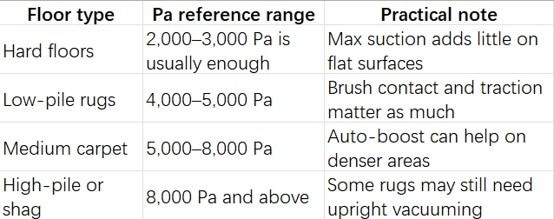
Hard floors are the forgiving case. Most debris sits on top, so steady airflow plus a side brush that actually kicks grit toward the intake does most of the work. In practice, 2,000 to 3,000 Pa is usually plenty. Most mid-range bots get through a week of kitchens and hallways without living in max suction the whole time.
Low-pile rugs still ask more of the machine. Stuff drops into the weave, pet hair wraps tufts, and the roller needs real agitation rather than intake pull alone. Most setups sit near 4,000 to 5,000 Pa when traction holds, and the brush stays down; wheel grip and brush geometry matter about as much as the printed Pa figure. Medium carpet, denser than a thin rug but short of shag, is where 5,000 to 8,000 Pa starts to matter for grit and dander driven into the pile. High piles and shag hide debris, choke airflow, and make a short robot work hard just to roll straight. At 8,000 Pa and up, the spec story starts to match heavy shedding, but no Pa rating fixes rugs that snag the brush or confuse navigation, even when the marketing sheet looks generous.
Treat the bands above as ballpark numbers, not a scoreboard. Brands do not all test Pa the same way, so 5,000 Pa on one label and 5,000 Pa on another label are not always the same pull in your hallway.
What Running at Max Suction Costs Over Time
The most powerful robot vacuum on the spec sheet may be the one that gets switched off most often. High suction means a louder motor, and a robot cleaning at full power during a work call, a nap, or a quiet evening tends to get rescheduled rather than tolerated. That trade-off is not about the vacuum being bad. It is about the setting being impractical for daily use.
Battery is a related issue. Max suction draws more energy, which can mean a recharge stop before the robot finishes a larger floor plan. Over a full week, a robot that uses lower power on hard floors and reserves stronger suction for carpet usually covers more ground per charge than one that runs at the same level everywhere. The savings on hard floors, where higher suction adds little anyway, are the ones that matter.
There is also what happens to the brush and the motor over months of use. High-torque operation puts more stress on rubber fins and bristles, and they can flatten or split faster when the robot runs at full power regularly on dense carpet. Side brushes spinning at full speed against baseboards wear down sooner as well. None of this shows up on a spec sheet, and neither failure is immediate. But a brush that has lost its shape agitates carpet less effectively, which means the airflow is doing more work than the brush, and that is when suction efficiency starts to slip.
Why Brush Design Matters as Much as Pa
The brush roll is what actually breaks debris loose from carpet fibers. Dust and pet hair do not sit on the surface the way they do on tile. They cling to individual fibers and settle below the pile. Suction by itself cannot lift what the brush has not already loosened.
A brush that skims instead of making contact, or one that presses so hard against a dense rug that it blocks airflow, makes a high-Pa robot feel weaker than expected. The result is often more noise for the same debris left behind. A brush that stays in contact, maintains the right pressure for the floor type, and moves debris toward the intake path is doing more useful work than another hundred Pa of suction in most rooms.
Hair management is part of the same issue. Once pet or human hair wraps around the roller, the bristles or rubber fins stop touching the floor the way they should. The robot may still move and make noise, but the carpet section it just passed may not be much cleaner. For homes with long hair or heavy shedding, an anti-tangle mechanism tends to protect suction performance more reliably over weeks of use than a bigger motor would.
How Smart Suction Helps on Rugs
Running at max power everywhere is a different thing from running at the right power for each surface. A robot that can detect carpet and increase suction only there uses its battery more efficiently, runs quieter on hard floors, and gives the motor a more sustainable workload. Carpet detection and auto-boost are the features that make a mid-range Pa number feel stronger in practice, because the suction is applied where it actually matters.
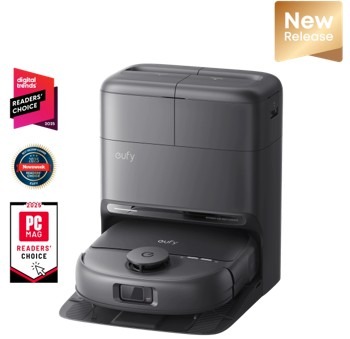
For mixed floors, there is one more variable worth naming: a vacuum-and-mop robot that drags wet pads across carpet creates a separate problem from weak suction. Mop auto-lift on rug detection keeps carpet cleaning dry. That is where the eufy Robot Vacuum Omni C28 addresses a few of these problems together. Its 15,000 Pa sits above the 8,000 Pa threshold for high-pile carpet, but what makes that suction more useful day to day is the DuoSpiral detangle brush, which keeps the airflow path from narrowing as hair accumulates, and the HydroJet roller mop, which lifts off rugs automatically. iPath 2.0 navigation helps with consistent coverage in low light and under furniture, which matters on carpet more than on hardwood, because one skipped pass on a rug is harder to spot until the debris is already ground in. 15,000 Pa is not always necessary. When the brush is clear, and the robot knows where the carpet is, it tends to go further.
Conclusion
Pa numbers are worth knowing, but easy to overread. Higher suction helps on low-pile rugs, medium carpet, and pet-heavy homes. On hard floors, navigation consistency, brush condition, and airflow management usually matter more than the peak number.
The best robotic vacuum cleaner for a home with mixed floors is the one that applies power where it makes a difference and stays manageable the rest of the time. When comparing top-rated robot vacuum cleaner options, how the robot handles carpet transitions, hair accumulation, and mop behavior on rugs tells you more than the Pa figure alone. For side-by-side comparisons on suction, navigation, mop features, and maintenance specs, the eufy robot vacuums collection is a practical starting point.
Also Read: Smart Home Organization in 2026
FAQs – Outdoor Lighting
1. What does Robot Vacuum Pa mean?
Robot Vacuum Pa refers to the suction pressure of a robot vacuum, measured in Pascals. A higher Pa rating generally means stronger suction, but overall cleaning also depends on brush design and airflow.
2. How much Robot Vacuum Pa is good for carpets?
Most low pile carpets clean well with around 4,000 to 5,000 Pa, while medium and high pile carpets often benefit from 5,000 Pa or more.
3. Is a higher Robot Vacuum Pa always better?
No. A higher Pa rating improves suction, but navigation, brush performance, carpet detection, and airflow management are equally important for effective cleaning.
4. Does using maximum suction reduce battery life?
Yes. Running a robot vacuum at maximum suction consumes more battery power, increases noise, and may reduce cleaning time before recharging.
5. What features should I consider besides Robot Vacuum Pa?
Look for anti tangle brushes, automatic carpet detection, suction boost, smart navigation, and mop lift features, as they significantly improve real world cleaning performance.
Author & Expert Review
Written By:  Gaurav Mishra | Civil Engineer & Content Writer

| Credentials: B.E. (Mahavir Swami College, Surat), Registered with Bhagwan Mahavir University (BMU). Experience: Civil Engineer with 5+ years of content writing experience, currently writing impactful articles for Gharpedia, part of SDCPL. Expertise: Specializes in writing well-researched content on residential construction, construction materials, design planning, on-site practices, and safety, blending technical accuracy with everyday clarity. Find him on: LinkedIn |
Verified By Expert: Farhan Shaikh – Senior Manager – Architect, SDCPL | Associate Member – IIA

This article has been reviewed for architectural and interior design accuracy by Farhan Shaikh, Senior Manager – Architect at Sthapati Designers & Consultants Pvt. Ltd. As the lead for all architectural and interior projects at SDCPL and an Associate Member of the Indian Institute of Architects (IIA), he brings hands-on experience in architectural planning, interior design, project coordination, and sustainable strategies. His review ensures the content reflects practical design considerations, industry best practices, and real-world applicability across both architecture and interior spaces.
Find him on : LinkedIn