





Table of Contents
Quick Summary
- Precast concrete stairs are factory-made staircase units designed for quick and efficient installation in residential and commercial buildings.
- These stairs offer excellent durability, structural strength, and fire resistance compared to traditional cast-in-situ staircases.
- Different types include solid flight stairs, spiral stairs, cantilevered stairs, and individual tread systems for modern architectural needs.
- Since they are manufactured in controlled environments, precast stairs provide uniform quality, smooth finishes, and accurate dimensions.
- Precast concrete stairs reduce construction time, labour dependency, maintenance requirements, and on-site construction waste, making them a cost-effective and reliable staircase solution.
Imagine your staircase arriving at the construction site completely ready, perfectly shaped, structurally strong and finished with precision. We know that the staircase becomes one of the most time-consuming and labour-intensive parts of a building project. Traditional concrete staircases require shuttering, reinforcement work, curing time, finishing and much more. All of these requirements usually contribute to slowing down the progress of projects. But thanks to precast concrete stairs, there is no messy shuttering work, lengthy curing time or weeks of waiting for the staircase to become usable. Factory-manufactured and designed for quick installation, precast concrete stairs have become a preferred choice in modern construction projects.
What are Precast Concrete Stairs?
Precast concrete stairs are reinforced concrete staircase units manufactured off-site in factories and later installed at the construction sites. They are usually designed as ready-made structural components that can be lifted into their location using cranes. Since they are factory-produced, they eliminate many common site-related issues such as uneven finishing, delayed curing, etc.
Another major advantage is speed. Once installed, the staircase becomes immediately usable, allowing workers to move between floors without relying on temporary ladders or scaffolding, thereby significantly improving construction efficiency and site safety.
To know more about it, read: What is a Precast Concrete?
In modern construction, these stairs are widely used in residential buildings, commercial complexes, industrial facilities, etc. In this blog, we will discuss its types and many other factors
which is making precast stairs a smarter alternative to traditional cast-in-situ staircases.
Types of Precast Concrete Stairs
Depending on the architectural design and structural requirements, they are available in the following styles.
1. Solid Flight Stairs
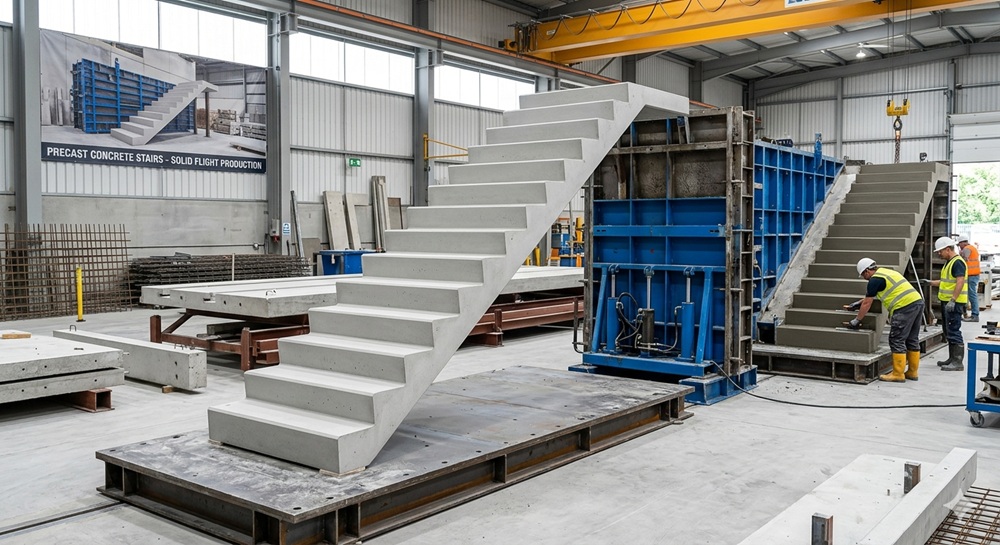
These are the most commonly used types of precast concrete staircase systems in residential and commercial buildings. Here, the treads, risers, and the supporting concrete beneath the staircase are cast as a single, solid reinforced concrete unit. They are durable and structurally stable. Since they are produced as a single piece, installation becomes faster and more reliable.
- Best for: Standard stairwells and fire escape routes.
- Installation: Usually lifted and positioned using cranes onto landing beams or lead-bearing walls.
Feature Blog Box – Components or Parts of a Staircase: Know Before You Design
2. Individual Tread and Riser Units
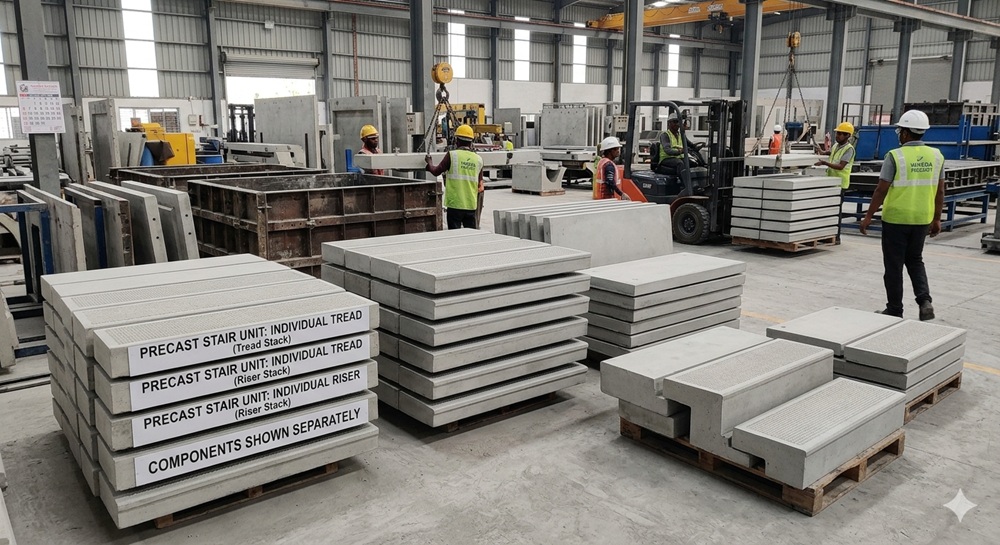
These stairs consist of separate components rather than a complete staircase flight. The individual units are fixed onto steel stringers, central spines or side support beams.
These stairs are popular in contemporary architecture because they create a lighter and more open appearance. It supports the concept of an open-riser staircase that improves light flow and visual openness.
- Best for: Custom architectural designs where a lighter, more open look is desired.
- Advantage: Allows greater flexibility in design and aesthetics.
3. Spiral and Helical Stairs
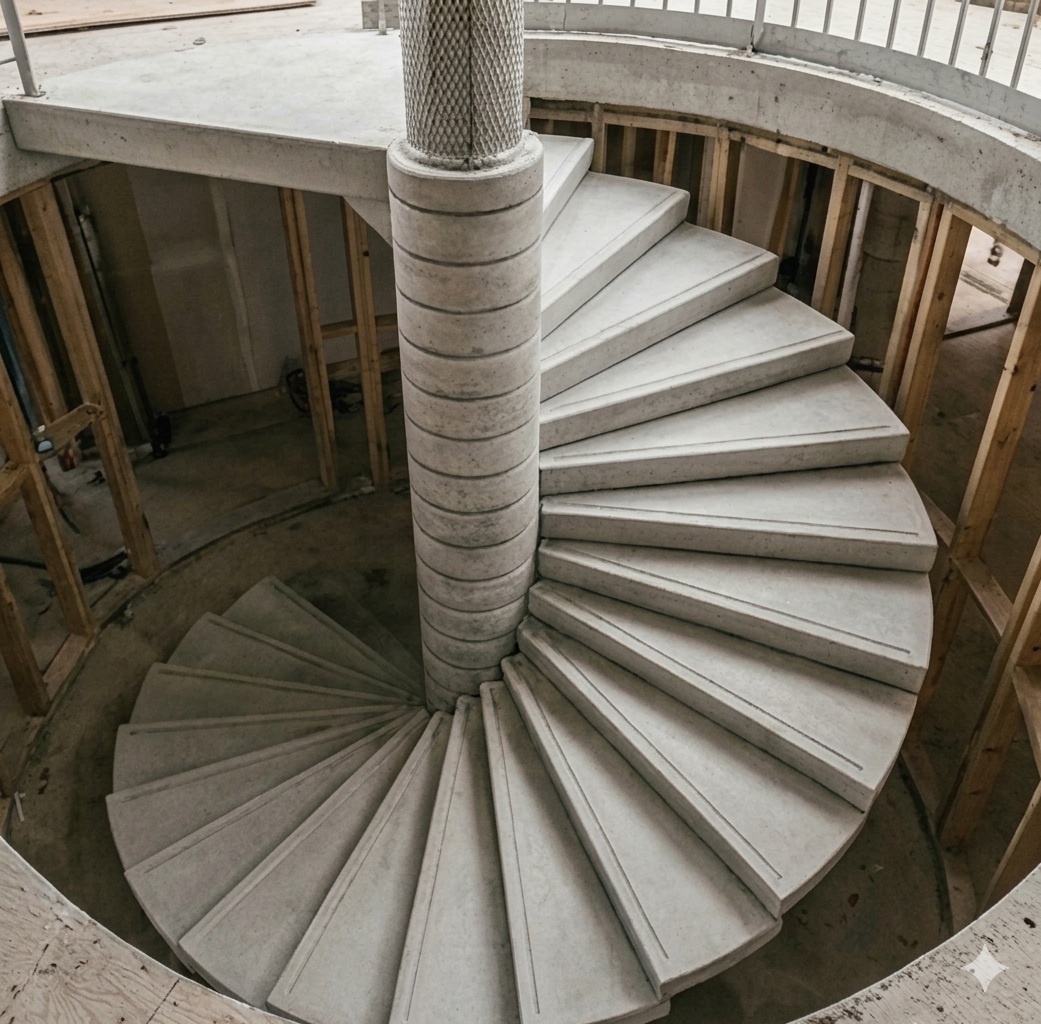
Precast technology is significantly effective for complex staircase geometries like spirals and helical stairs. These are often cast as a series of individual tread units that stack around a central vertical column, or as a complete monolithic curved flight. Because factory manufacturing ensures precision, the curves and dimensions remain highly accurate, something often difficult to achieve through on-site construction.
- Best for: Space-saving transitions or high-end architectural focal points.
- Advantage: Since these are factory-made, the complex curves are mathematically perfect, which is difficult to achieve with on-site formwork.
4. Cantilevered Stairs
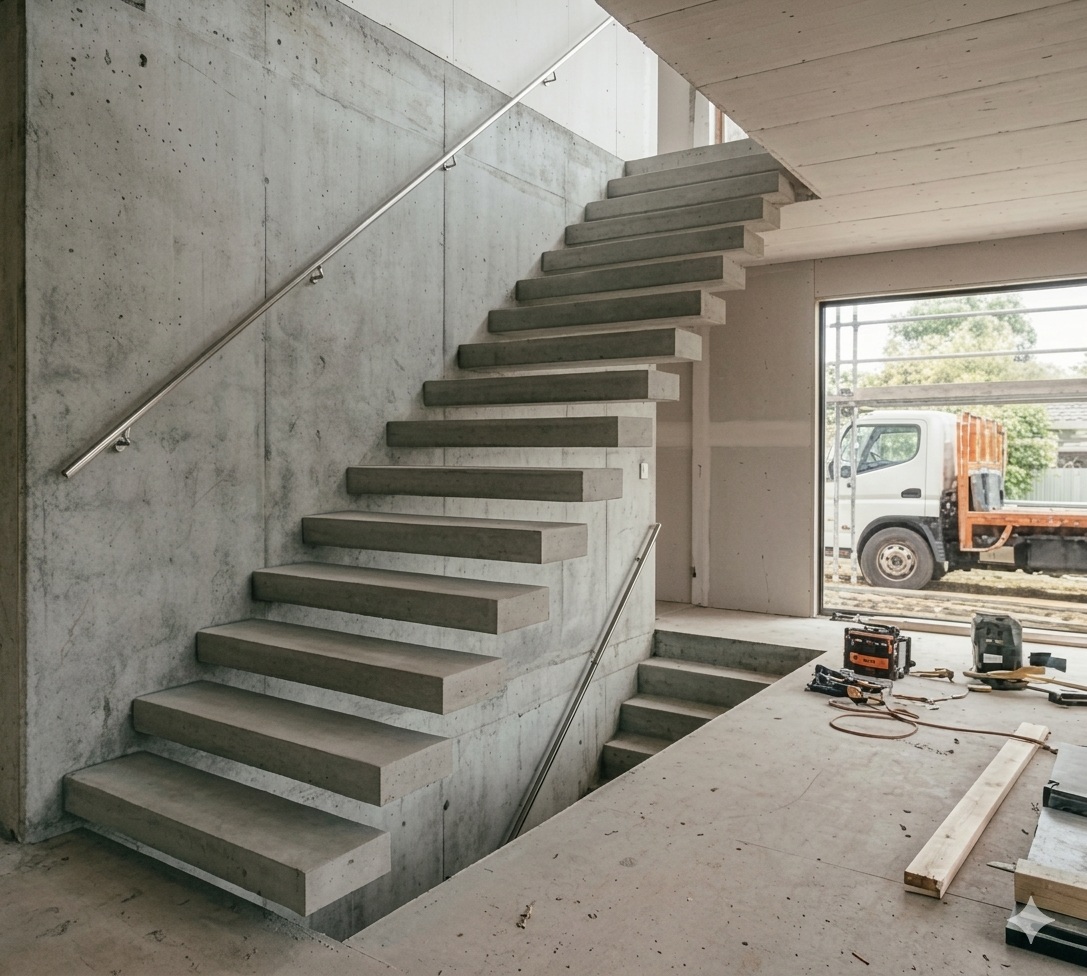
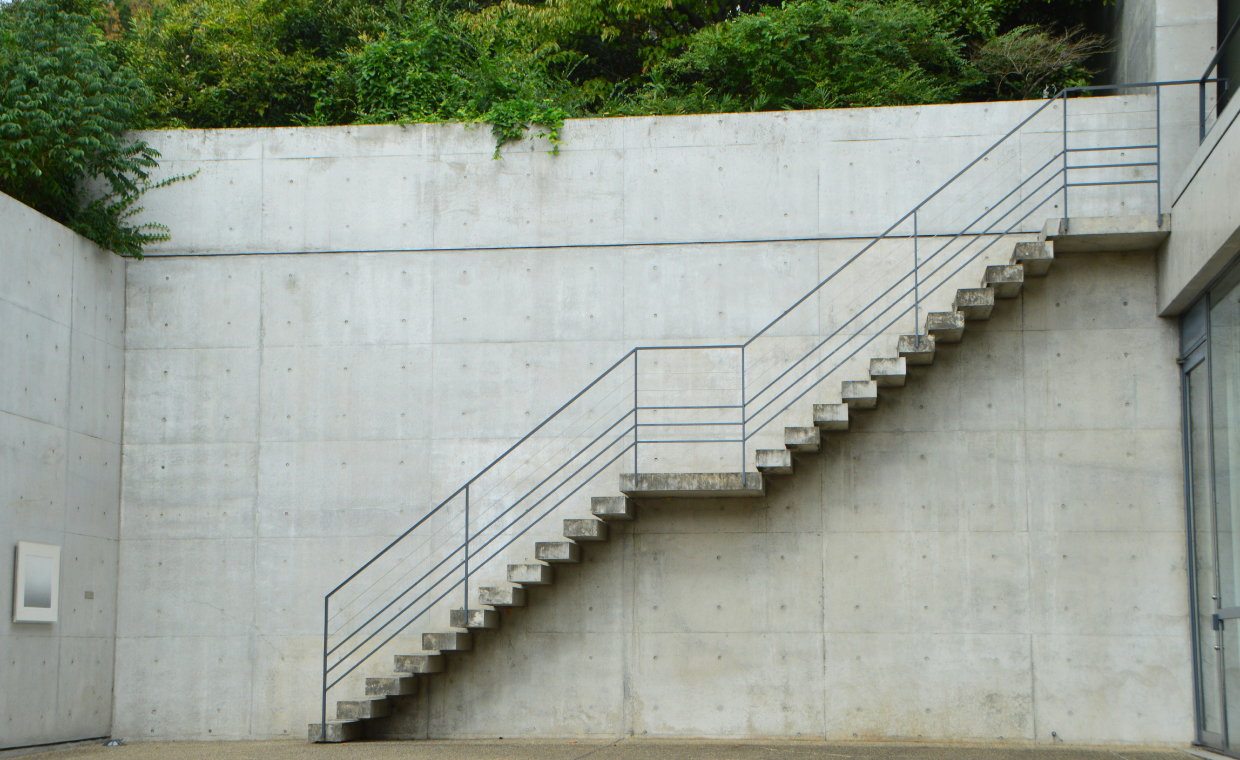
In this modern style, the treads appear to “float” out from a wall without visible support on the outer edge. The precast treads are manufactured with internal reinforcement that allows them to be deeply anchored into a reinforced concrete wall or a hidden steel stringer.
- Best for: Minimalist interior design, modern luxury homes and contemporary architectural designs.
- Advantages: High strength, durability and modern look.
Key Structural Components of Precast Concrete Stairs
- Landing Slabs: Precast stairs usually come with integral landings or are designed to rest on separate precast landing slabs. These landings provide stability and facilitate load transfer between staircase flights.
- Nosing Details: Precast units often include cast-in “nosings,” or the front edge of the step, which can be textured or fitted with anti-slip inserts during the casting stage.
- Soffit Finish: The underside of the staircase, called the soffit, usually comes with a smooth fair-faced finish. This reduces the need for additional plastering and allows direct painting.
Benefits of Using Precast Concrete Stairs in Home Construction
1. Faster Installation
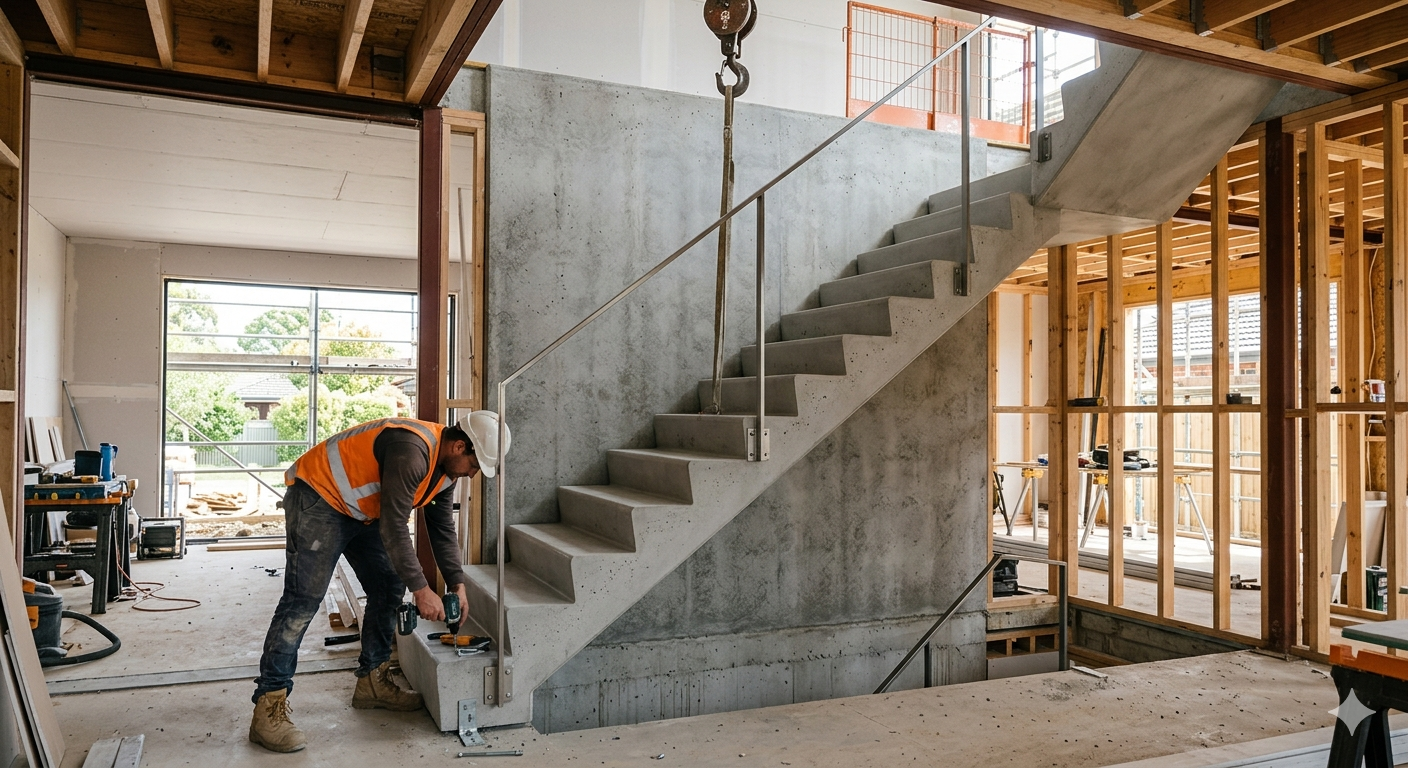
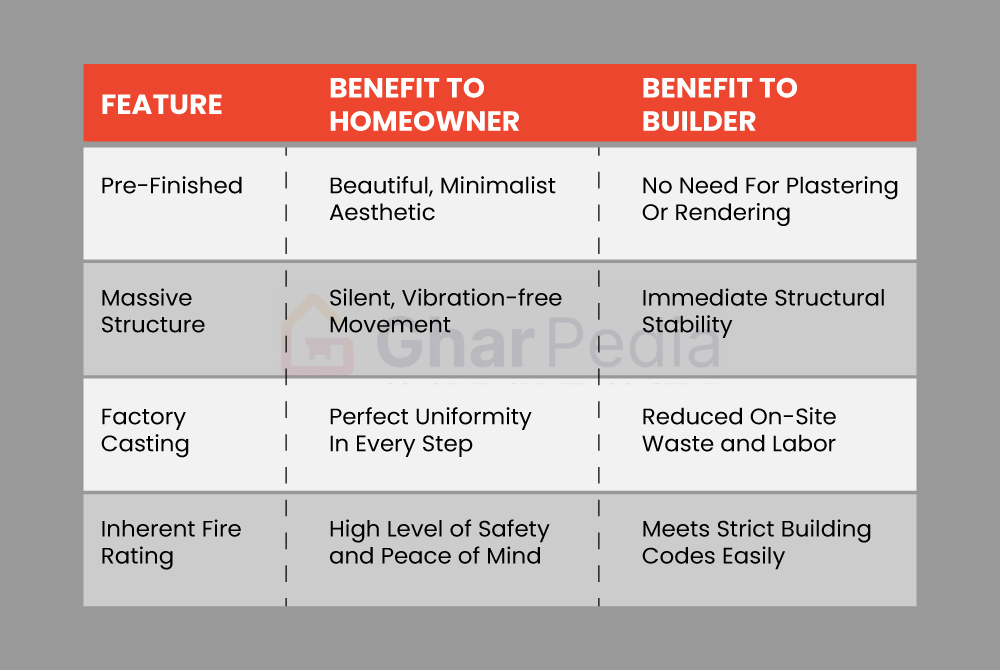
One of the biggest advantages of precast concrete stairs is the speed. Unlike cast-in-situ stairs, which require time-consuming processes such as extensive formwork, curing time, and scaffolding, precast units are ready for installation. Once lifted into position and secured, they can be used immediately. Significant reduction in overall construction time makes precast concrete stairs desirable.
2. Better Surface Finish
As they are factory-made in a controlled environment using steel moulds, the finish is far more consistent than that of on-site pouring. The underside (soffit) and the sides are smooth, often requiring only a coat of paint rather than labour-intensive plastering. Treads and risers are mathematically uniform, reducing the risk of tripping hazards caused by uneven step height and width.
3. Enhanced Durability and Fire Resistance
Concrete naturally resists fire, moisture, pests and decay. Unlike timber stairs, precast concrete stairs do not creak, warp or deteriorate over time. Their high strength and durability make them suitable for both indoor and outdoor applications.
4. Improved Safety Features
Manufacturing in a factory allows safety elements to be incorporated directly into the staircase design. These include anti-slip nosings, integrated handrail fixing points, uniform tread and riser dimensions, and better load-bearing reliability. Such features improve both user safety and long-term performance.
5. Sound Insulation
One of the most overlooked benefits in residential settings is acoustic performance. Due to their density and mass, precast concrete stairs absorb sound more effectively than lightweight stair materials. Unlike wood that may produce creaking or thumping noises, precast stairs provide quieter movement between floors.
Things to Know Before Buying Precast Concrete Stairs
Before selecting precast concrete stairs for your project, you must pay attention to a few practical considerations.
Accurate Measurements
Since precast units are manufactured in advance, precise site measurements are critical. Errors in floor height, landing size, or alignment can create installation challenges later. So, ensure that the stair rise ranges between 150-200mm, tread depth ranges between 250-300mm, and stair width usually starts from 900m for comfortable movement.
Installation Requires Proper Planning
These precast units generally require cranes or lifting equipment for installation. The supporting walls, beams, and landing areas must be properly prepared before delivery.
Joint Connections
Proper grouting and fixing methods are essential for achieving crack-free performance and long-term stability. Always ensure installation follows structural recommendations.
Finishing Costs May Vary
Although the factory finish is smooth, homeowners may still choose additional finishes like tiles, stone cladding, paint or polished concrete finishes.
Code Compliance
In seismic or earthquake-prone zones, it is important to confirm that the staircase design complies with relevant IS codes and structural standards.
Cost of Precast Concrete Stairs
The cost of precast concrete stairs varies depending on design, size, and location.
Approximate Cost Factors:
- Design complexity (straight, spiral, custom)
- Transportation distance
- Crane and installation charges
- Material grade and finish
Although the initial cost may be slightly higher, precast stairs reduce labour and time costs, making them cost-effective overall.
| Feature | Precast Concrete Stairs | Cast-in-Situ Stairs |
| Construction Time | 1-2 days install | 7-14 days cure/form |
| Precision | High tolerances | Variable on-site |
| Labour | Semi-skilled | Skilled formwork |
| Quality Control | Factory-standard | Site-dependent |
| Flexibility | Custom pre-made | Fully adjustable |
Endnote
Precast concrete stairs are a modern, efficient, and durable solution for staircase construction. Major benefits of precast concrete stairs include fast installation, superior quality, and long-term performance. By reducing construction time and ensuring safety, precast staircases stand out as a smart alternative to the traditional method of casting concrete stairs.
Also Read: In Which Type of Projects We can Use Precast Concrete?
Precast Concrete Stairs FAQs
1. Why choose precast concrete stairs over cast-in-situ concrete stairs?
Precast concrete stairs are factory-made and ready to install, whereas cast-in-situ concrete stairs need skilled labour for formwork and concreting. Precast concrete stairs are installed quickly compared to cast-in-situ, which takes days to set and become usable.
2. How are precast concrete stairs installed?
They are lifted using cranes, placed in position, aligned, and fixed securely to the structure.
3. What is the disadvantage of precast concrete stairs?
The biggest disadvantage of precast concrete stairs is that they cannot be changed as per our needs once it is casted in the factory. It cannot be modified after installing.
Author & Expert Review
Written By:  Nidhi Patel | Civil Engineer & Content Writer

| Credentials: B.E. (Mahatma Gandhi Institute of Technical Education and Research Centre), Registered with Gujarat Technological University (GTU). Experience: Civil Engineer with 3+ years of content writing experience, currently writing blogs for Gharpedia, part of SDCPL. Expertise: Specializing in SEO-optimized blogs and long-form articles focused on home improvement, construction, interiors and architect topics. I create well-researched, reader-focused content that balances technical accuracy with clarity, making complex subjects easy to understand. Find her on: LinkedIn |
Verified By Expert: Ravin Desai – Co Founder – Gharpedia | Co Founder – 1 MNT | Director – SDCPL

This article has been reviewed for technical accuracy by Ravin Desai, Co-Founder of Gharpedia and Director at Sthapati Designers & Consultants Pvt. Ltd. With a B.Tech. in Civil Engineering from VNIT Nagpur and an M.S. in Civil Engineering from Clemson University, USA, and over a decade of international and Indian experience in the construction and design consultancy sector, he ensures all technical content aligns with industry standards and best practices.
Find him on: LinkedIn