





Table of Contents
Quick Summary
- Renting is a major financial decision that directly impacts your savings and long-term goals.
- Understanding how much you should spend on rent helps you maintain financial balance and avoid overspending.
- The common 30% rent rule suggests spending a portion of income on housing, but it may not suit everyone.
- Factors like location, income stability, and existing expenses influence rent affordability.
- The 50/30/20 budgeting rule offers a more flexible approach to balance needs, wants, and savings.
- Always calculate rent based on income minus expenses and savings.
- Consider hidden costs like utilities, commute, and maintenance before finalizing a house.
- The ideal rent is one you can comfortably sustain while achieving future financial stability.
You’ve found a house that feels perfect. The location is great, the light and ventilation are perfect and you have already imagined yourself living in that home. Then comes the big question, quiet and unsettling: “Can I afford this rent?”
It is a moment most of us have been through, but few have an answer or a solution to tackling the rent affordability questions.
Renting is not just a lifestyle choice; it is a financial commitment that affects your goals in a big way. Spend too little and you will have to compromise on comfort or convenience. Spend too much and you risk limiting your ability to save, invest or even breathe easy at the end of the month.
But, understanding how much rent you can truly afford is less about rules and numbers and more about clarity.
So, let’s stop guessing and break this down in a way that actually works for your life.
Understanding Rent Affordability: How Much Income Should You Spend on Rent?
Rent affordability plays a crucial role in financial planning because rent is often the largest recurring expense for tenants. Many landlords, especially in Western countries, follow the guideline that a tenant’s monthly income should be at least three times the monthly rent.
However, questions still remain:
- What percentage of salary should be spent on rent?
- Is the 30% rent rule still practical today?
- How should tenants calculate their rent affordability?
Instead of relying only on a fixed percentage, it is wise to evaluate your rent-to-income ratio along with other personal financial factors.
The Foundation: The 30% Rule
For decades, the standard financial benchmark for housing affordability has been the 30% rule. The principle is simple: 30% of your gross monthly income (the total amount you earn before taxes and deductions) should be allocated to rent and basic utilities. This rule acts as a financial buffer, helping you avoid bearing the “cost-burdened” while still leaving room for savings, debt repayment and daily expenses.
The Reality Check: Why One Size Doesn’t Fit All
While the 30% rule is a useful starting point, it is not universal; it is only a guideline and not a rule. Just as building specifications change based on the environment (e.g., seismic zones requiring different reinforcement than floodplains), your financial decisions should adapt to your personal circumstances.
Here are situations where you may need to adjust your rent-to-income ratio:
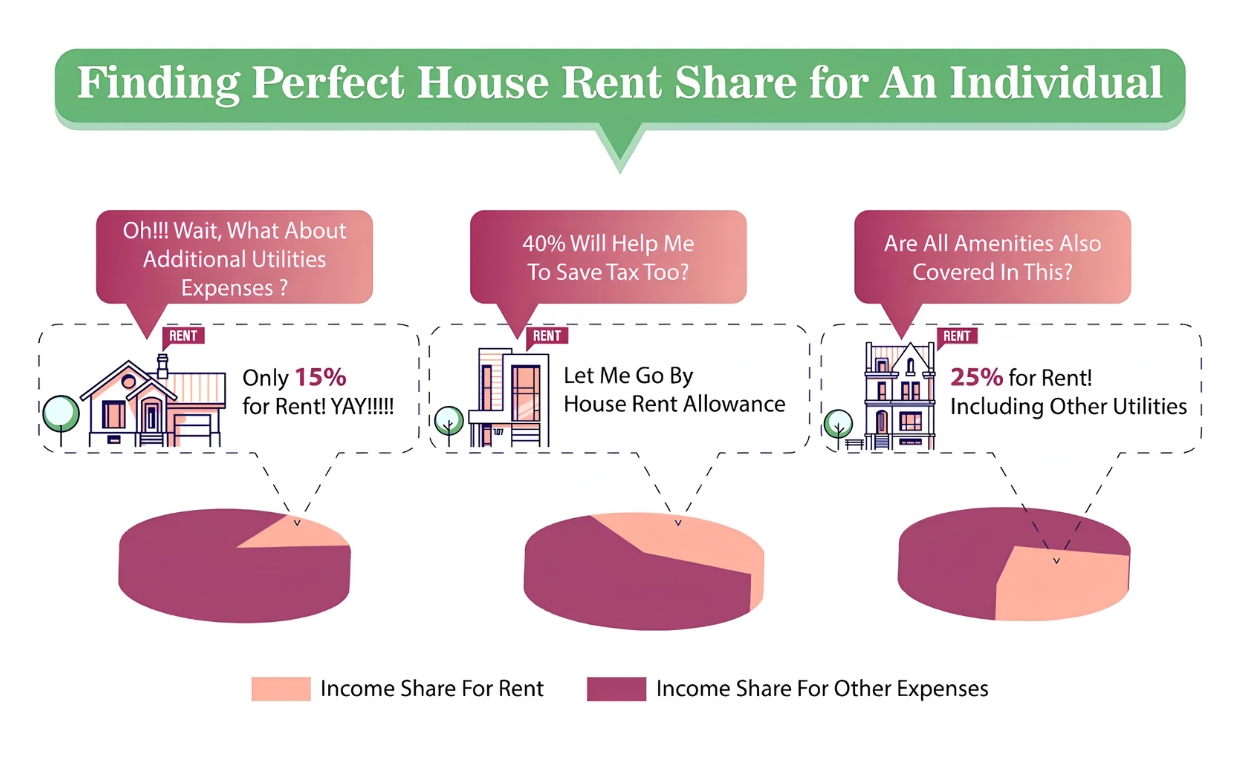
- High-Cost-of-Living (HCOL) Markets: In major metropolitan cities, the 30% threshold is often unrealistic. In such cases, you may have to stretch it to 35-40%, but then you must be willing to control your “discretionary” spending.
- High Debt Obligations: If you are paying off significant student loans or credit card debt, spending 30% on rent could be outrageous. You would prefer a lower rent (perhaps 25%) to free up funds for repayment.
- Aggressive Financial Goals: If you are saving for a home or building an emergency fund, choosing lower rent can help increase your savings rate.
A Broader Approach: The 50/30/20 Framework
If the 30% rule does not suit your situation, then consider the 50/30/20 budgeting framework. Unlike the 30% rule that focuses solely on rent, this method looks at your entire financial picture.
| 50/30/20 | ||
| Category | Allocation | What it Includes |
| Needs | 50% | Rent, utilities, groceries, transportation, and minimum debt payments. |
| Wants | 30% | Dining out, entertainment, hobbies, travel, subscriptions. |
| Savings/Debt | 20% | Emergency fund, retirement investments, extra debt repayment. |
This framework gives the liberty to adjust finances as per your priority. For instance, if you find a perfect apartment that pushes your “Needs” category to 55%, you can adjust your “Wants” category to 25% to keep your finances in check.
A Simple Way to Calculate Your Rent Budget
Rent calculation should be based on logic and never on guesswork. Use this practical approach:
Step 1: Calculate your monthly take-home income.
Step 2: Subtract essential expenses
- Food
- Travel
- EMIs
- Insurance
- Utilities
Step 3: Allocate savings (at least 20%)
Step 4: What remains = Your safe rent range
Quick Example:
| Monthly Income | Expenses + Savings | Safe Rent Budget |
| ₹30,000 | ₹20,000 | ₹8,000 – ₹10,000 |
| ₹50,000 | ₹30,000 | ₹12,000 – ₹18,000 |
| ₹1,00,000 | ₹60,000 | ₹25,000 – ₹35,000 |
Hidden Charges

Before signing a lease agreement, it is essential to evaluate the total cost of renting.
Ask yourself:
- Utilities: Are water, gas, electricity, and trash included? If not, estimate these costs.
- The Commute: Will a cheaper rent in a distant suburb increase travel expenses?
- Maintenance & Fees: Are there parking fees, mandatory amenity fees, or high security deposits?
- Insurance: Have you factored in renters’ insurance?
The ‘Rent Stress Test’
Now that you understand how well you can zero in on a rent, take this test to further be sure about what rent you can afford. Ask yourself these simple questions:
- Can I still save at least 15 per cent of my income after paying rent?
- Will I feel financially comfortable 10 days before my next salary?
- Can I handle an unexpected expense without stress?
- Am I compromising heavily on essentials just to afford this home?
If you hesitate on more than one of these, your rent may already be causing stress, but you haven’t yet understood it.
Final Thoughts: So, How Much Rent Should You Pay?
There is no one-size-fits-all answer. The right rent is the one that allows you to meet your current needs while continuing to build toward your future.
If you are struggling to save consistently, rely heavily on credit, are stressed about finances constantly, think twice before spending even on necessities, and have no financial buffer, then it already means you should revisit your housing choice.
If you are on a tight budget, then identify the variable you can control, eliminate hidden expenses, and ensure your housing choice supports, not threatens, your financial stability.
In the end, rent is not just a number; it’s a decision that shapes your daily comfort, financial security, and future freedom.
Also Read: What’s Most Important While Renting House? Size? Rent? Locality?
FAQs on How Much You Should Spend on Rent
1. How much of my income should I spend on rent?
No fixed percentage works for everyone. The traditional 30% rule is outdated. A safe rental amount depends on your income stability, family responsibilities, location, utilities, and savings goals. Ideally, choose a rent that still allows you to comfortably cover essential expenses and save monthly.
2. Is the 30% rent rule still valid in India?
Not universally. Research shows the 30% rule does not suit all income groups. For low-income earners, 30% leaves too little for other needs, while high-income earners may find 30% unnecessarily high. Your rent should be based on your financial capacity, not a fixed formula.
3. How do I calculate rent affordability based on my salary?
Use this approach: Income – Expenses – Savings = Rent Budget
4. What factors should I consider before choosing a rental house?
Key factors include:
- Employment type and income stability
- Family size and required house dimensions
- Location and commuting distance
- Utility costs and extra expenses
- Furnishing needs (unfurnished vs. fully furnished)
- Amenities, safety, and building floor level
- Future financial commitments
These collectively determine the rent you can sustain comfortably.
Author & Expert Review
Written By:  Nidhi Patel | Civil Engineer & Content Writer

| Credentials: B.E. (Mahatma Gandhi Institute of Technical Education and Research Centre), Registered with Gujarat Technological University (GTU). Experience: Civil Engineer with 3+ years of content writing experience, currently writing blogs for Gharpedia, part of SDCPL. Expertise: Specializing in SEO-optimized blogs and long-form articles focused on home improvement, construction, interiors and architect topics. I create well-researched, reader-focused content that balances technical accuracy with clarity, making complex subjects easy to understand. Find her on: LinkedIn |
Verified By Expert:  Vaidehi Desai | Owner – Gharpedia | MBA (Finance), PGDHRM

This article has been reviewed for financial, operational, and content quality accuracy by Vaidehi Desai, Owner and Operations Lead of Gharpedia, a venture of Sthapati Designers & Consultants Pvt. Ltd. With over 10 years of experience in managing an educational and media platform in architecture, construction, and home-building, along with a strong background in finance, business operations, and human resource management, she ensures the content meets organizational standards, factual reliability, and overall quality benchmarks.
Find her on : LinkedIn