





Table of Contents
Quick Summary
- Start with water testing to identify hardness, TDS, iron and other contaminants before selecting treatment equipment.
- Plan the equipment location around pressure, accessibility, salt storage and servicing requirements.
- Separate treated and untreated water lines so softened water is supplied only where it provides a practical benefit.
- Provide drainage points for softener regeneration and RO reject water during the plumbing stage.
- Plan power connections near treatment equipment for convenient and reliable operation.
- Consider water storage and disinfection so treatment takes place in the correct sequence.
- Make these decisions during construction to avoid expensive alterations, exposed pipes and inefficient systems later.
Courtesy: Magnific
Walk into most Indian homes that have a water softener and you will find the same picture. The unit is bolted into a corner of the utility area, installed a year or two after the house was finished. A flexible pipe runs across the floor to the nearest floor trap. The salt sack sits on the ground beside it because there is no shelf. Every tap in the house delivers softened water, including the garden tap and the toilet cisterns, which is expensive and pointless.
None of that is the installer’s fault. He arrived after the walls were plastered and did the only thing the building allowed.
Almost every decision that would have made the system cheaper to run and easier to service had to be taken months earlier, at the plumbing layout stage, and nobody was thinking about water treatment then. This is a short account of what those decisions are.
Test Before You Plan Anything
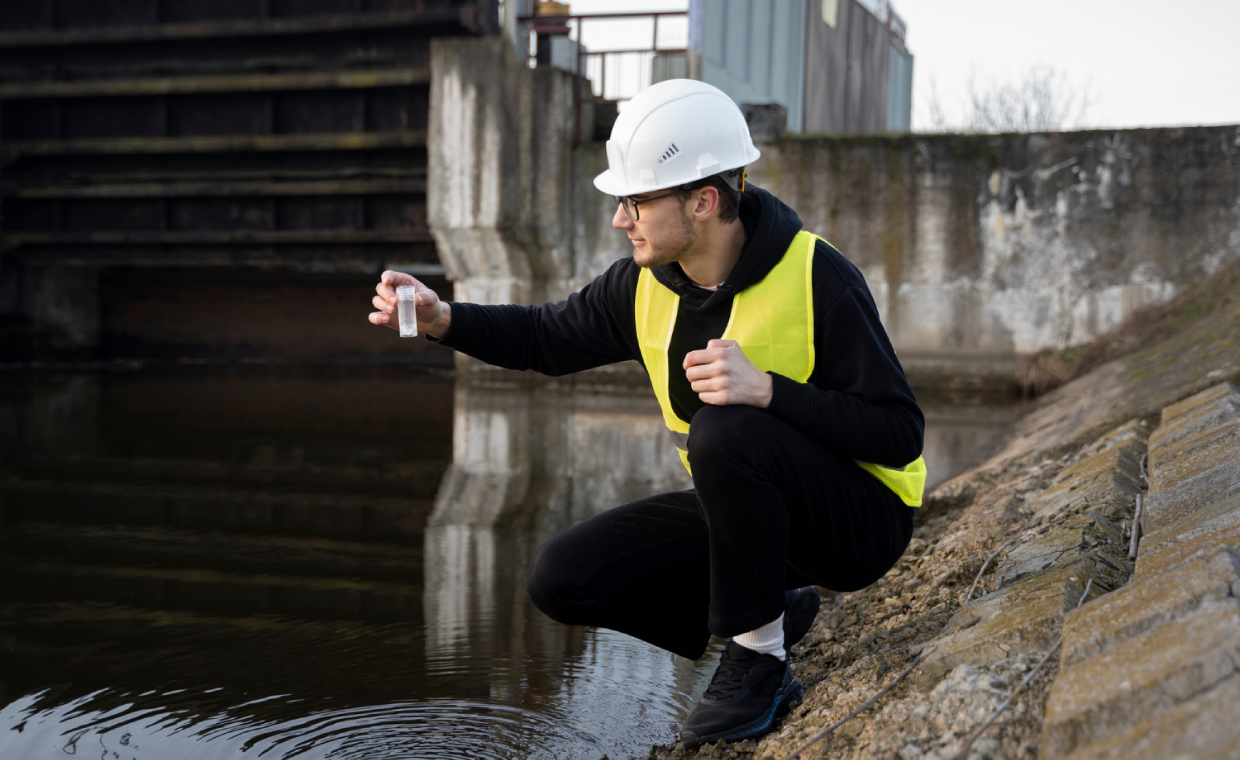
Courtesy: Magnific
Everything downstream depends on what is actually in your water, and a surprising number of households buy equipment on the basis of a salesman’s handheld TDS meter reading taken at the front door.
Get a proper lab test. For a house on borewell or tanker supply, the numbers that matter are total dissolved solids, total hardness as CaCO₃, and iron. If the source is groundwater, add fluoride and nitrate. A test at a recognised laboratory costs less than the cheapest purifier on the market and it is the only thing that tells you whether you need a softener, an RO unit, both, or neither.
The sequence is the same at every scale. Manufacturers such as Hiju, who build treatment systems for industrial plants, begin every specification from a feed water analysis before proposing a single piece of equipment, for the straightforward reason that the alternative is guessing. A house deserves the same order of operations, even though the equipment is smaller.
One clarification worth having early, because it is the most common confusion in the market: hardness and TDS are not the same thing. A softener removes calcium and magnesium through ion exchange. It stops scale. It does not reduce TDS – groundwater at 800 ppm treated by a softener is still around 800 ppm, just no longer scaling. If you want the number down, that is reverse osmosis, and it is a different machine solving a different problem.
Where the Equipment Sits, And Why Pressure Decides It
Most Indian houses run on the same arrangement: municipal or borewell supply into an underground sump, a pump lifting to the overhead tank, gravity feed from the tank to the fixtures.
That layout has one consequence that determines almost everything else. A whole-house softener needs working pressure to operate and, more importantly, to backwash and regenerate. Gravity feed from a rooftop tank does not provide much roughly a tenth of a bar for every metre of height difference, which on the upper floors approaches nothing at all.
So a whole-house softener belongs on the pump discharge line, between the sump and the overhead tank, where it has pressure to work with. Put it downstream of the tank and it will underperform from the day it is commissioned, and no amount of servicing will fix it.
Two things follow from that position, and both need to be settled on the plumbing drawing:
The softener needs a physical location near the pump, not wherever there happens to be a gap. Allow for the resin vessel, the brine tank next to it, headroom above the control valve, and enough clearance to actually stand there and work.
And salt has to reach it. Regeneration consumes sacks of salt on a recurring basis. If the pump room is at the back of the plot behind a narrow side passage, someone will be carrying 25 kg bags along that passage for the next twenty years.
The Split That Cannot Be Retrofitted
Courtesy - Magnific
This is the single most valuable thing to get right at construction stage, and the one most often missed.
You do not want softened water everywhere.
Bathrooms, the water heater, the washing machine and the dishwasher benefit from it less scale, less soap, longer appliance life. The garden tap, the car washing point, floor cleaning outlets and toilet flushing do not. Softening that water achieves nothing except higher salt consumption and more frequent regeneration.
Splitting the line into a soft branch and a hard branch is trivial when the plumbing is being laid. It is a wall-breaking exercise afterwards. Mark it on the drawing: which outlets are on the treated line, which stay on raw supply.
The same logic applies to drinking water. An RO unit at the kitchen sink treats a few litres a day, which is all anyone drinks. Running the whole house through RO to get clean drinking water is one of the more expensive mistakes available.
Two Drains That Nobody Plans For
Treatment produces waste, and both streams need somewhere to go.
Softener regeneration discharges a concentrated brine every few days. It is short, it is high-flow, and it is very salty.
RO reject runs continuously while the unit is producing. Domestic RO recovery is poor commonly two to three litres rejected for every litre delivered.
Provide a proper drain connection at each equipment location during construction. Otherwise you get the flexible pipe across the floor, which is what everyone ends up with.
Two things to avoid. Softener brine should not be routed into a septic tank; the salt load interferes with the biological process the tank depends on. And it should not be discharged into a garden or soak pit that you care about – sodium degrades soil structure over time, and the damage is slow enough that nobody connects it to the softener.
RO reject is a different case. It is not clean, but at typical municipal source TDS it is often perfectly usable for floor washing, toilet flushing, or a utility area tap. Capturing it needs a small storage tank and a line, both of which are easy at construction stage and awkward later. Whether it suits garden use depends on your source TDS, so check the number before committing to it.
Power, And the Order of Things
Metered softener valves and RO units both need power. A socket near each equipment position, on a circuit that will not be switched off when the house is locked up, costs nothing to add now.
One last ordering question. If you are treating water before it enters the overhead tank, remember that anything stored in that tank is exposed to whatever gets into it the tank is not a sterile vessel, and it usually has an imperfect lid. Disinfection, if you are doing it, belongs downstream of storage, not upstream. Treating for hardness before the tank and for microbiology after it is the sequence that actually works.
None of this is complicated, and none of it is expensive at the right moment. A drain point, a socket, a split in the distribution line and a metre of floor space in the right room. The total cost of providing all four during construction is negligible against the cost of the house.
The cost of not providing them is a pipe across the floor, salt in the septic tank, and a system that softens the water going to your toilet.
Also Read: Why Good Plumbing Starts Long Before the First Pipe Is Installed
Frequently Asked Questions – Water Treatment in House Construction
1. Why should water quality be tested before installing a treatment system?
Water testing identifies hardness, TDS, iron and other contaminants, helping homeowners choose the right treatment instead of buying unnecessary equipment.
2. Should a whole-house water softener supply every tap?
No. Softened water is generally more useful for bathrooms, water heaters, washing machines and dishwashers, while garden, toilet and cleaning outlets can remain on the raw water line.
3. Where should a whole-house water softener be installed?
It should generally be positioned where adequate water pressure is available, such as on the pump discharge line, with sufficient space for servicing, salt storage and regeneration.
4. Does a water softener reduce TDS?
No. A water softener mainly removes calcium and magnesium responsible for hardness. Reverse osmosis is used when reducing dissolved solids is necessary.
5. What drainage should be planned for water treatment equipment?
A suitable drain should be provided for softener regeneration discharge and RO reject water. Planning these connections during construction avoids exposed flexible pipes and difficult modifications later.
Courtesy: Featured Image(Magnific)
Author & Expert Review
Written By:  Gaurav Mishra | Civil Engineer & Content Writer

| Credentials: B.E. (Mahavir Swami College, Surat), Registered with Bhagwan Mahavir University (BMU). Experience: Civil Engineer with 5+ years of content writing experience, currently writing impactful articles for Gharpedia, part of SDCPL. Expertise: Specializes in writing well-researched content on residential construction, construction materials, design planning, on-site practices, and safety, blending technical accuracy with everyday clarity. Find him on: LinkedIn |
Verified By Expert: Ravin Desai – Co Founder – Gharpedia | Co Founder – 1 MNT | Director – SDCPL

This article has been reviewed for technical accuracy by Ravin Desai, Co-Founder of Gharpedia and Director at Sthapati Designers & Consultants Pvt. Ltd. With a B.Tech. in Civil Engineering from VNIT Nagpur and an M.S. in Civil Engineering from Clemson University, USA, and over a decade of international and Indian experience in the construction and design consultancy sector, he ensures all technical content aligns with industry standards and best practices.
Find him on: LinkedIn