



Table of Contents
Quick Summary
- Discover what defines mixed-use development in Thailand and how residential, retail, education and leisure spaces work together.
- Understand the growth of mixed-use projects and the main formats available to buyers.
- Explore land ownership, leasehold structures and condominium ownership rules.
- Learn about planning standards, environmental approvals and infrastructure requirements.
- See why integrated communities appeal to families seeking convenience, green spaces and nearby amenities.
- Examine Reignwood Park as an example of a large-scale mixed-use community in Thailand.
- Consider location, ownership structure, facilities, connectivity and long-term value before buying.
A home is only one part of how a family lives. Schools, cafes, fitness, green space and places to meet neighbours shape each day just as much, which is why mixed-use development in Thailand is drawing growing attention from homebuyers and investors alike. By planning residential, commercial, educational and leisure spaces within a single master plan, these communities place daily essentials close to home. This guide looks at how the model works, how it is regulated, and what to consider when choosing a community.
What Defines Mixed-Use Development in Thailand
A mixed-use development brings several functions together within one planned area. Homes sit alongside retail, dining, offices, hotels, education and recreation, and each element is designed to support the others. The idea is often summarised as “live, work, play”, with residents able to move between functions on foot, by bicycle or with a short drive.
For households, the appeal is practical. Daily needs that would otherwise be spread across a city are gathered in one setting, and the surrounding facilities become part of the home’s value from the outset.
The Growth of Mixed-Use Development in Thailand
The model has expanded steadily as land in central areas has become more valuable. The Real Estate Information Center (REIC) of the Government Housing Bank reports that, in the first half of 2025, the Bangkok Metropolitan Region had 152 active mixed-use projects with a combined gross floor area of about 23.7 million square metres, an increase of 1.42% from the second half of 2024.
The same survey shows a maturing market. A total of 121 projects, representing 70.77% of floor area, were completed, while 16 projects were under construction and nine were partially completed. REIC estimates that a further 5.47 million square metres of mixed-use floor area will enter the market between 2025 and 2029, which points to continued demand for integrated living.
Two Forms of Mixed-Use Development in Thailand
Thai real estate distinguishes between two broad forms. The first is the master-planned development, where several buildings and uses are spread across a walkable area. Offices, residences, retail, hotels and leisure facilities each have their own space and are linked by shared infrastructure.
The second is the mixed-use condominium, where different unit functions, such as apartments and commercial space, sit within a single structure. Both serve urban living well. Master-planned communities offer the added benefit of open space, since a larger site allows for gardens, lakes, walking routes and low-density residences alongside the commercial and educational elements.
Land and Ownership in Mixed-Use Development in Thailand
Land values in central Bangkok have risen considerably. Many large projects in the central business district therefore adopt long-term leasehold structures, as noted in REIC’s analysis. Buyers comparing locations may find it useful to consider how ownership structures differ between central districts and master-planned communities in newer growth corridors.
For international buyers, Thai law sets out clear routes. Foreign nationals are entitled to own condominium units within the 49% foreign ownership quota of a building, and land can be held under leasehold agreements of up to 30 years under the Civil and Commercial Code, according to Lexology’s guide to Thai real estate law. Buying property abroad can feel unfamiliar at first, and the process is smooth when buyers understand the options, associated costs and key procedures, with guidance from experienced legal and real estate professionals.
Planning Standards Behind Mixed-Use Development in Thailand
Large developments follow a framework of planning and building rules. High-density projects require Environmental Impact Assessment (EIA) approval and comply with setback, fire safety, and height requirements under Ministerial Regulation No. 55 B.E. 2543 (2000) and the Building Control Act.
Planning policy is also evolving. A study of mega-project standards describes the Planned Unit Development (PUD) measure in the draft Bangkok Comprehensive Plan, which applies to projects larger than 100 rai (about 40 acres) or 500 sub-plots. In return for planning flexibility, developers provide public infrastructure, connecting roads and at least 7.5% of the project area as public open space (Wisuttinun, Panitchpakdi and Chayanun, 2020). These measures reflect a shared goal: large communities that contribute green space and connectivity to their surroundings.
Why Mixed-Use Development in Thailand Appeals to Families
Families today look for a balance of privacy and convenience. They value quiet, secure surroundings and want daily essentials within easy reach. A mixed-use community responds to both wishes, with the calm of a private residence and a cafe, a school or a fitness facility only minutes away.
Every generation benefits. The school run is shorter, errands are simpler and weekends offer more choice close to home. Older relatives gain easier access to everyday amenities, and younger family members enjoy independence in a safe, familiar setting. Shared cafes, open green areas and a calendar of events also give neighbours regular reasons to meet, which builds a sense of belonging over time. Communities that welcome visitors from the wider area stay lively and connected to their surroundings.
Mixed-Use Development in Thailand at Reignwood Park
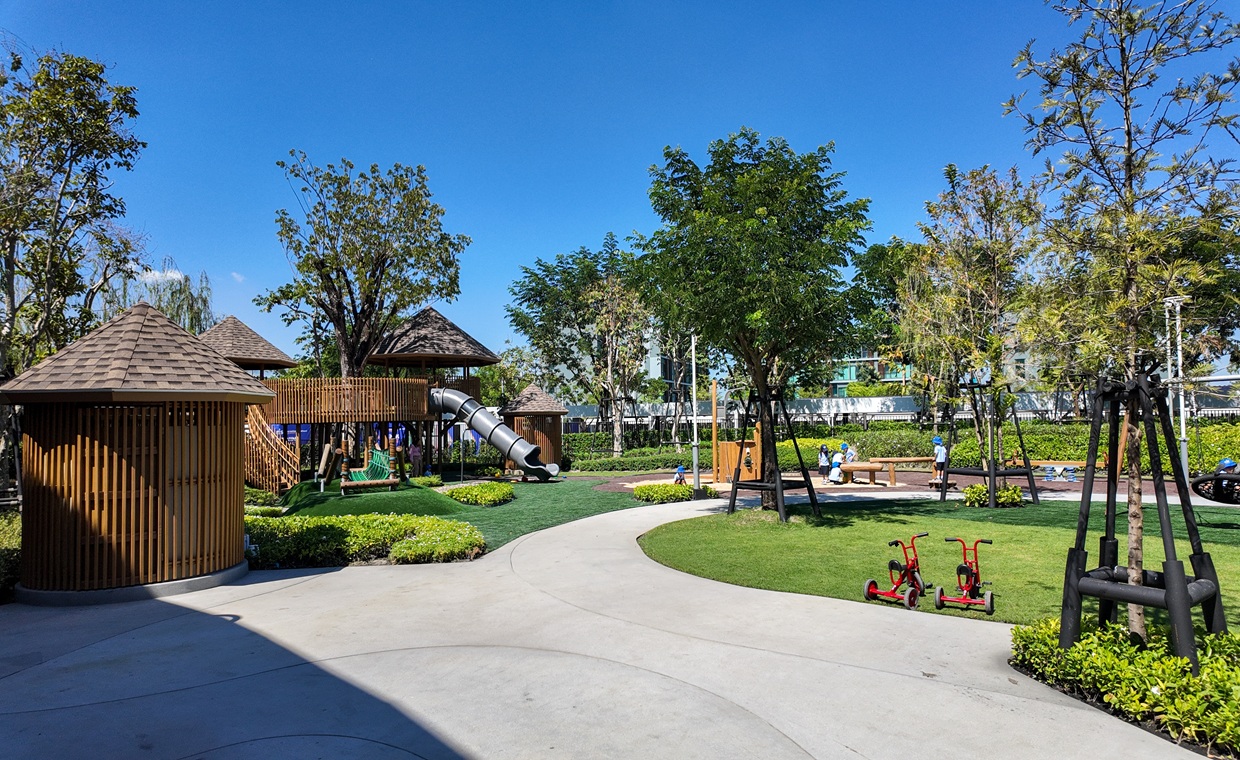
Reignwood Park is a 50 billion baht development spanning approximately 800 acres (2,000 rai), set within Robinswood Golf Club. It was named Best Luxury Mega Township Development (Asia) at the 2025 Asia Property Awards, and it brings residences, education, retail and lifestyle facilities together in one integrated community.
The Reignwood Residence Collection offers three residential sub-brands. SERENO provides 309 square metres of living space on plots of 155 to 255 square wah (about 0.15 to 0.25 acres). ESTATE is a collection of 41 bespoke residences on plots of 1.5 to 3 rai (approximately 0.6 to 1.2 acres). SONIA offers 180 square metres of living space, with prices starting from THB 16.8 million.
Daily life is supported by KIS International School Reignwood Park, the Reignwood Sports and Performance Center (RSPC), a 10-kilometre running and cycling lane and a clubhouse gym. The Park 11 zone, which is open to the public, includes Park 11 Community Mall, Silverskin Cafe and Bistro, Topaz Reignwood Park and Get Growing Reignwood Park. Events such as Reignwood Run and Winter Lovesong bring the community together through the year.
The location is well connected, at approximately 45 minutes from Suvarnabhumi Airport (SVB), about 50 minutes from Bangkok’s CBD and 30 to 40 minutes from Don Mueang International Airport.
Also Read: INKAS Safes on Building a Secure Safe Room
FAQs
1. What is mixed-use development in Thailand?
It is a planned development that combines residential, commercial, educational, leisure and other facilities within one integrated area.
2. Can foreigners buy property in mixed-use developments in Thailand?
Foreign buyers can generally purchase condominium units subject to the 49% foreign ownership quota. Land ownership is more restricted, so leasehold arrangements are commonly considered.
3. What should buyers check before purchasing a mixed-use property?
Buyers should review the ownership structure, location, developer reputation, facilities, maintenance costs, planning approvals, accessibility and long-term development plans.
4. Why are mixed-use developments popular with families?
They bring everyday facilities such as schools, shops, restaurants, sports facilities and green spaces closer to residential areas, reducing travel time and improving convenience.
5. Is Reignwood Park a mixed-use development in Thailand?
Yes. Reignwood Park combines residential, education, retail, sports, leisure and community facilities within a large master-planned development.
Author & Expert Review
Written & Verified By :  Ravin Desai – Co Founder – Gharpedia | Co Founder – 1 MNT | Director – SDCPL

| Credentials: B.Tech. in Civil Engineering from VNIT Nagpur and M.S. in Civil Engineering from Clemson University, USA. Co-Founder of Gharpedia and Director at Sthapati Designers & Consultants Pvt. Ltd.. Experience: Civil engineering professional with over a decade of international and Indian experience in the construction and design consultancy sector, with expertise in technical review and industry practices. Expertise: Specializes in reviewing technical content related to civil engineering, construction, design consultancy, materials, and industry practices. He ensures content is technically accurate, aligned with industry standards, and reflects practical construction and design best practices. Find him on: LinkedIn |