




Table of Contents
Quick Summary
- Selecting the right materials requires learning how to choose concrete sleepers for a retaining wall based on height, soil load, and site conditions.
- Sleepers generally come in 80mm, 100mm, and 120mm options. Taller walls hold back heavier soil and require thicker profiles and closer post spacing.
- Standard 40MPa concrete works for most domestic projects, while high-density 55MPa concrete is ideal for taller or heavy-load commercial walls.
- A B2 durability rating ensures the concrete withstands continuous contact with damp soil or coastal environments without premature degradation.
- Match the visual appearance to your landscape using smooth grey, timber-look, or block-pattern finishes.
- Any retaining wall exceeding standard height limits (e.g., 600mm) or supporting surcharge loads needs professional engineering drawings and council permits before installation.
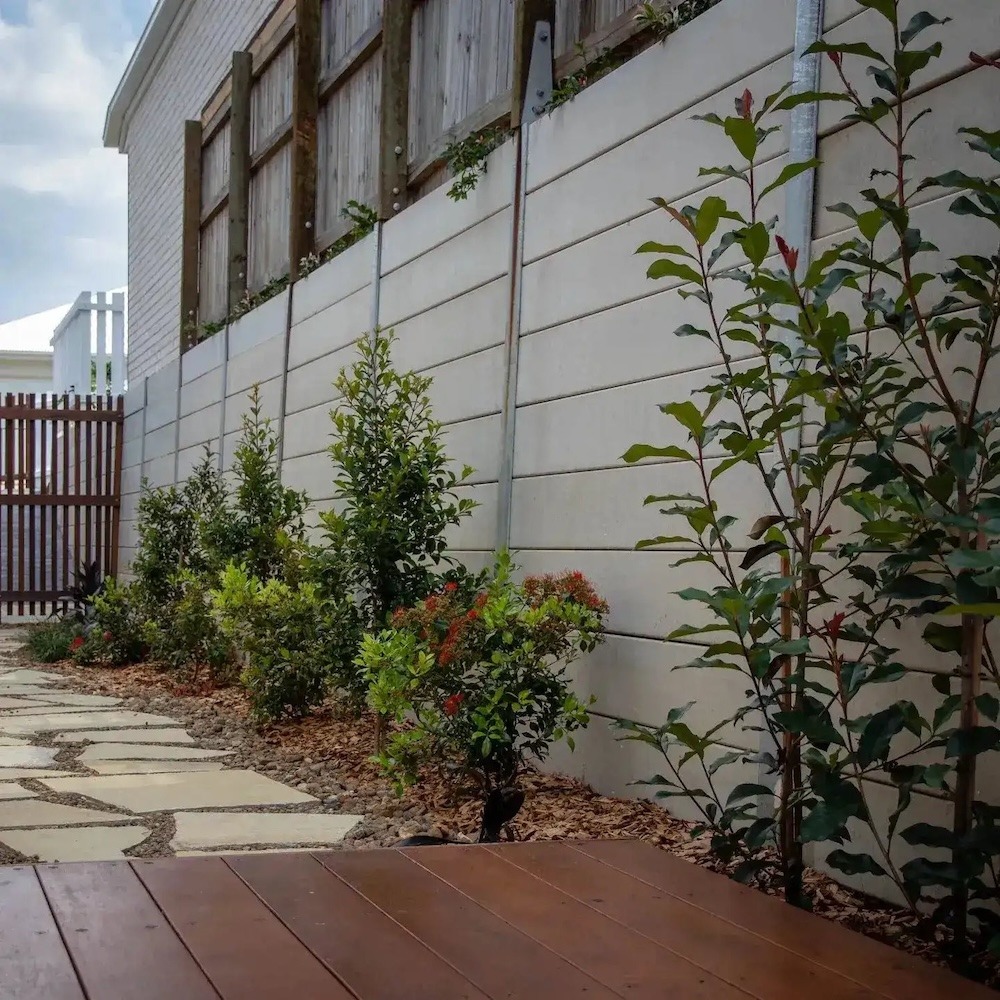
Courtesy - australianlandscapesupplies
Concrete sleepers have largely replaced timber for retaining walls because they don’t rot or warp, and they won’t need replacing every decade or so. They slot between steel posts to form the wall face, so the choice comes down to matching sleeper thickness to your wall height and picking the concrete strength and durability that suit the load. Then there’s the finish, which is about where the wall sits and how much of it you’ll actually see. Get those right and the wall will outlast most of what’s around it.
How Thick Should the Sleepers Be?
Concrete sleepers usually come in three thicknesses: 80mm, 100mm and 120mm. Thickness is the main thing you match to wall height, because a taller wall holds back more soil and the sleepers span a wider gap between posts.
As a rough guide:
- 80mm suits low garden edging and short walls where the load is light.
- 100mm is the common mid-range choice for standard residential walls.
- 120mm suits taller walls and sloping sites where the soil load is heavier.
Length matters alongside thickness. Sleepers come in 1600mm, 2000mm and 2400mm, and the longer the sleeper, the more it flexes under load, so longer spans generally want a thicker sleeper and posts set closer together. Don’t treat these as fixed rules for a tall wall. Anything holding back a serious amount of soil should have its thickness and post spacing confirmed by an engineer rather than guessed from a table.
What Do The 40mpa and 55mpa Strength Grades Mean?
MPa (megapascals) measures the compressive strength of the concrete: how much load it takes before it fails. A 40MPa sleeper is the standard grade and handles most domestic walls without trouble. A 55MPa sleeper is denser and stronger. That matters on taller or commercial walls, and anywhere you want extra margin against cracking over the years.
The higher grade costs more, and for a low garden wall it’s usually more than you need. Where it earns its place is on walls carrying real height or load, or where a failure would be expensive to put right. If an engineer has specced your wall, follow the grade on the drawings.
What Does the B2 Durability Rating Mean?
Durability is separate from strength. It’s about how well the concrete resists the environment over decades, and it’s set out in AS 3600, the Australian standard for concrete structures. A B2 rating covers exposure conditions like coastal areas and soil contact, which is exactly what a retaining wall deals with. Buried sleepers sit against damp soil for their whole life, so a durability rating built for that exposure is worth checking before you buy, particularly near the coast.
Choosing A Finish and Sourcing the Sleepers
Finish is where personal taste comes in, and it changes both the look and the price. The common profiles are smooth grey, timber-look (moulded to mimic timber grain) and block-pattern (a stacked-stone or brick appearance). Sleepers also come sealed or unsealed, and the sealer is a factory-applied coating that helps hold colour and repel staining.
Smooth grey sleepers are the usual choice for walls that will sit behind planting or fencing, while timber-look and block-pattern profiles are made to be seen, and a factory-applied sealer keeps colour and texture rich on feature walls near pools and alfresco areas. Because finishes and thicknesses vary so much between yards, it is worth comparing them in person from a supplier that stocks concrete sleepers across the full range rather than the two or three profiles a general hardware store tends to carry. Australian Landscape Supplies, based at Eagle Farm in Brisbane, carries smooth, timber-look and block-pattern sleepers in both 40MPa and 55MPa grades and delivers along the east coast from northern New South Wales to north-east Queensland.
Seeing the profiles in daylight before you commit is worth the trip, because a timber-look finish that photographs well can read very differently against your own fence or paving. The same supplier runs a free retaining wall calculator that turns your wall measurements into a materials list of sleepers, steel posts and brackets, which saves guessing quantities and helps you compare the real cost of one grade or finish against another.
Do You Need Engineering or Council Approval?
This shapes your sleeper choice, so sort it early. In most parts of Australia a retaining wall over 600mm high, or one carrying a surcharge load like a driveway or a wall above it, needs council approval and an engineer’s design. Retaining wall design is covered by AS 4678, and the engineer’s drawings will usually dictate the sleeper thickness and post spacing, which takes the guesswork out of the decisions above.
Under 600mm and on a stable site you’ve generally got more freedom to choose, though it’s still worth building to the same standard. A wall that fails is far more expensive to fix than it was to over-spec in the first place.
Final Thoughts
Match the thickness to your wall height and pick the strength grade to suit the load rather than defaulting to the cheapest. Check the durability rating if the wall sits in soil or near the coast, and choose the finish in person where you can. If the wall is over 600mm or holding back anything significant, get it engineered before you order a single sleeper.
Also Read: Key Benefits of Retaining Walls for Your Landscape
FAQs on How to Choose Concrete Sleepers for Retaining Wall
01. How long do concrete sleepers typically last?
Concrete sleepers are built to last for decades without rotting, warping, or decomposing, making them a much longer-lasting alternative to traditional timber sleepers.
02. Can concrete sleepers be used for garden beds and vegetable patches?
Yes, sealed or smooth concrete sleepers are safe for garden beds because, unlike treated timber, they do not leach chemicals into the surrounding soil over time.
03. What type of steel posts are needed to install concrete sleepers?
Retaining walls constructed with concrete sleepers typically use heavy-duty steel posts, such as H-beams (for joining sleepers inline) and C-channels (for end posts), to secure the wall face.
04. Do concrete sleepers require drainage behind the wall?
Yes, proper drainage (like a perforated pipe and aggregate backfill) is essential behind any concrete sleeper wall to prevent hydrostatic pressure buildup from trapped water and soil load.
05. Can I cut concrete sleepers to size on-site?
Yes, they can be cut using a concrete demo saw or angle grinder fitted with a diamond blade, though it is best to plan post spacing to avoid unnecessary cuts.
Courtesy - Featured Image(Magnific)
Author & Expert Review
Written By:  Nidhi Patel | Civil Engineer & Content Writer

| Credentials: B.E. (Mahatma Gandhi Institute of Technical Education and Research Centre), Registered with Gujarat Technological University (GTU). Experience: Civil Engineer with 3+ years of content writing experience, currently writing blogs for Gharpedia, part of SDCPL. Expertise: Specializing in SEO-optimized blogs and long-form articles focused on home improvement, construction, interiors and architect topics. I create well-researched, reader-focused content that balances technical accuracy with clarity, making complex subjects easy to understand. Find her on: LinkedIn |
Verified By Expert:  Ravin Desai – Co Founder – Gharpedia | Co Founder – 1 MNT | Director – SDCPL

This article has been reviewed for technical accuracy by Ravin Desai, Co-Founder of Gharpedia and Director at Sthapati Designers & Consultants Pvt. Ltd. With a B.Tech. in Civil Engineering from VNIT Nagpur and an M.S. in Civil Engineering from Clemson University, USA, and over a decade of international and Indian experience in the construction and design consultancy sector, he ensures all technical content aligns with industry standards and best practices.
Find him on: LinkedIn