





Table of Contents
Quick Summary
- Looking for a front entrance that stays attractive with minimal upkeep? This guide explains how rocks and boulders can replace high maintenance landscaping.
- Understand the difference between pebbles, cobbles, rocks, and boulders before choosing materials.
- Learn proper boulder placement, drainage preparation, spacing, and colour selection.
- Explore eight practical front yard landscaping ideas using rocks for different property styles.
- Compare the long-term maintenance and costs of rock landscaping versus mulch.
- Find tips for selecting the right rock size and creating a balanced, natural looking entrance.
- Discover how planning tools can help visualise your landscape before installation.
Rocks solve a problem mulch never quite fixes: they don’t wash away, fade, or need replacing every spring. If your entrance beds are eating up a weekend every month, swapping turf and mulch for stone, gravel, and a few well-placed boulders can cut that work down to almost nothing. Below are practical front yard landscaping ideas with rocks, sizing guidance, and a real look at the maintenance trade-offs, so you can plan an entrance that still looks sharp five years from now.
Rocks vs. Boulders: Know the Difference Before You Buy
Suppliers use these terms loosely, so it helps to know the rough sizing before you call one:
- Pebbles and river rock – under 3 inches, sold by the ton, used for ground cover and drainage beds.
- Cobbles – 3 to 10 inches, good for borders and transition zones between beds and lawn.
- Rocks (medium) – 10 to 20 inches, often used as small accent pieces or grouped in threes.
- Boulders – anything above roughly 20 inches or 100+ pounds, usually placed one at a time and priced individually rather than by weight.
Rock does the quiet work: drainage, ground cover, weed suppression. Boulders do the visual work: they anchor a bed the way a piece of furniture anchors a room. Most front yard boulder landscape design that actually looks intentional uses both, not one or the other.
How to Use Large Rocks in Landscaping the Right Way
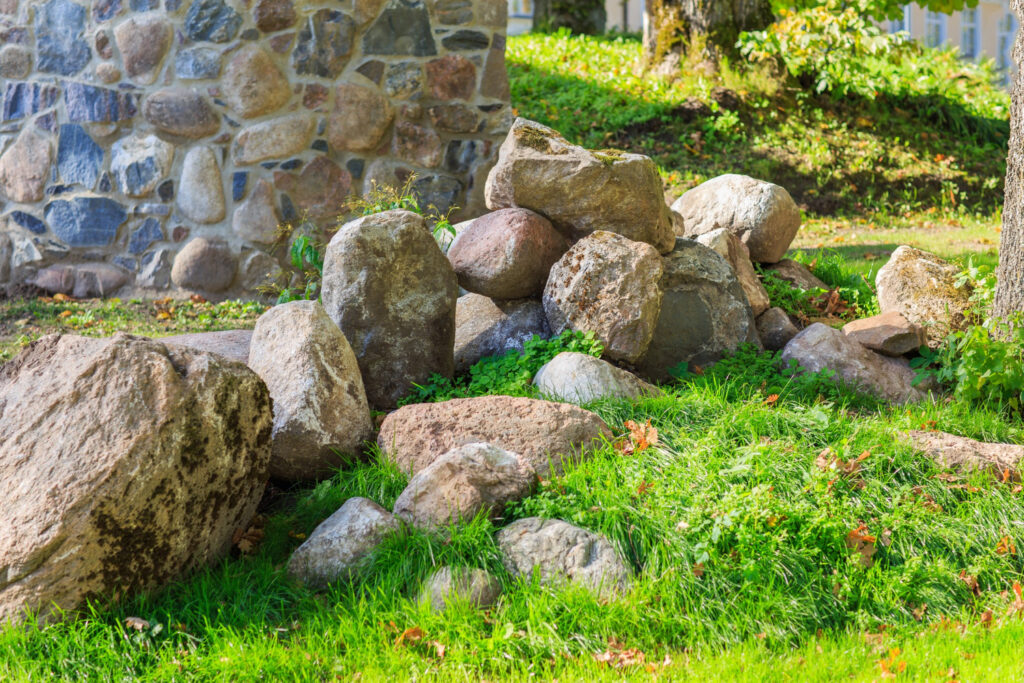
This is where most DIY attempts go wrong, and it’s rarely about the rock itself.
Bury a third of it. A boulder sitting on top of the soil like a dropped bowling ball reads as fake. Dig it in until roughly a third of its height disappears below grade. It should look like the ground grew around it, not like it landed there yesterday.
Skip the even spacing. Landscapers call evenly spaced, same-size rocks the “meatball effect,” and it’s the fastest way to make an expensive install look cheap. Group boulders in odd numbers – three or five – at varying distances, with the largest set slightly off-center as the anchor.
Match the stone to the house. A gray granite boulder next to a warm brick exterior fights the palette. Tan, buff, or rust-toned fieldstone tends to sit better against red brick and wood siding; gray and blue-gray river rock pairs more naturally with stucco, stone veneer, or cooler-toned siding.
Prep the base before anything else. Skip this and every other step is wasted. Remove sod, lay landscape fabric only where you’re using rock as ground cover (not under boulders, where it just traps water against the stone), and grade the bed so water drains away from the foundation rather than toward it.
8 Front Yard Boulder Landscape Design Ideas for a Low-Maintenance Entrance
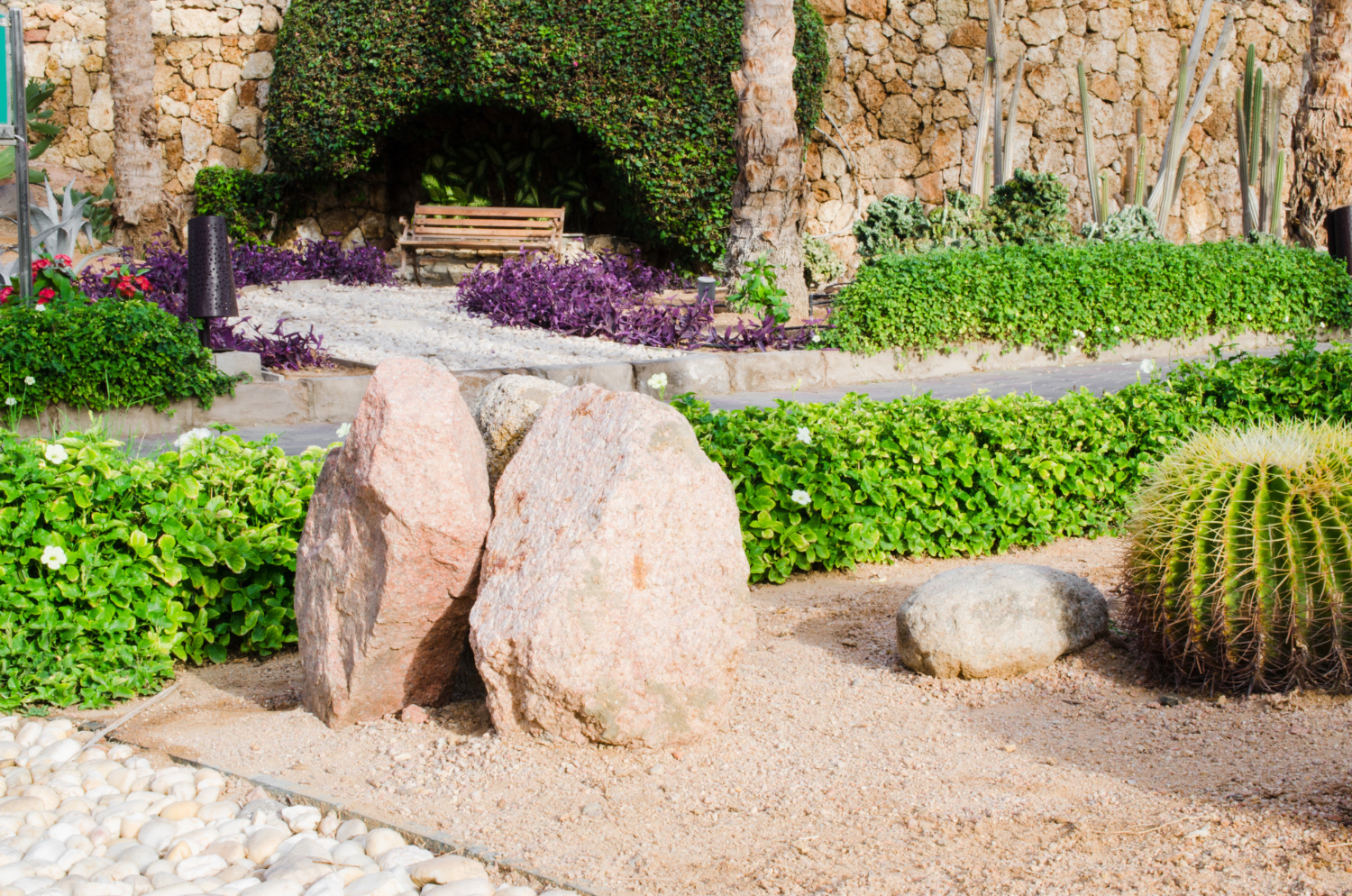
1. Boulder cluster flanking the walkway
Set three graduated boulders on each side of the entry path, largest closest to the porch. It reads as a threshold without a single plant to trim.
2. Dry creek bed along the drip line
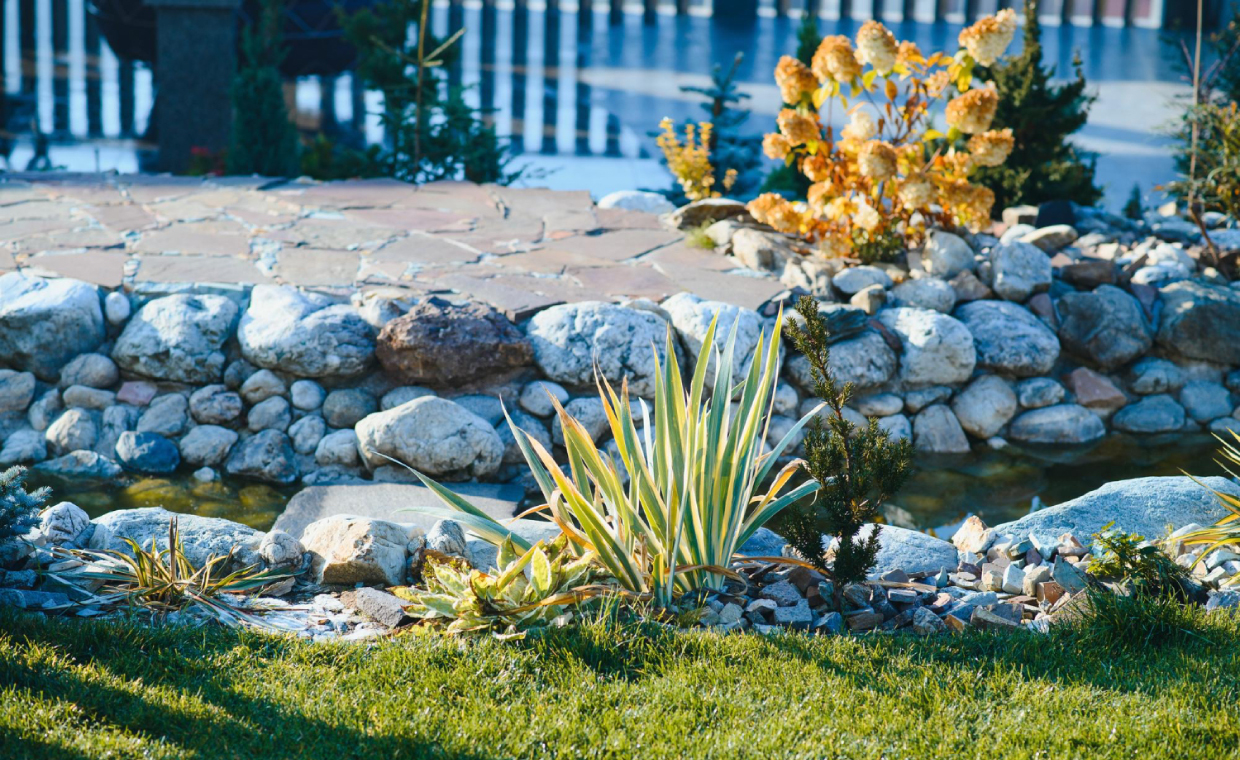
A meandering channel of river rock under the roofline solves splashback and erosion at the same time it looks designed. Vary the rock size within the channel – larger stones at the “banks,” smaller river rock in the “current” – so it reads as water-carved rather than poured from a bag.
3. Single anchor boulder as a focal point
One oversized boulder, off to one side of the entrance, does more for curb appeal than a symmetrical flower bed and needs zero upkeep. Works especially well flanking a mailbox post or at the corner where a walkway meets the driveway.
4. Rock mulch bed replacing foundation turf
Strip the grass in the 2–3 foot band against the house and fill it with crushed granite or pea gravel over fabric. This is the single highest-impact, lowest-effort swap for homes where the lawn right against the foundation never grows well anyway.
5. Terraced boulder retaining wall
On a sloped entrance, stacked boulders hold the grade and replace a mulched slope that erodes every heavy rain. Two or three low terraces, planted lightly at the top tier, look far less institutional than poured concrete or timber retaining walls.
6. Large rocks framing an address marker or mailbox
A pair of matched boulders at the base of a mailbox or house-number post gives it a built-in look instead of a post stuck in grass. Bury both boulders a third deep so they read as a base, not an obstacle someone will mow around.
7. Xeriscape gravel bed with native grasses
Swap the entire front bed for decomposed granite or buff gravel, three or four boulders as punctuation, and drought-tolerant native grasses in odd clusters. This is the closest thing to a true no-water, no-mow front yard that still reads as intentional landscaping rather than a construction site.
8. Boulder steppers with a pea gravel path
Flat-topped boulders set as stepping stones through a pea gravel bed replace a poured path entirely. It costs more upfront per square foot than concrete, but there’s no cracking, no resealing, and no edging to maintain.
Front Yard Landscaping with Large Rocks: The Maintenance Math
This is the part most rock-vs-mulch articles skip. Here’s roughly how the two compare over five years for a typical 150–200 sq ft front bed:
| Factor | Mulch | Rock / Boulders |
| Replenishment | 1–2 times per year | Rarely, if ever |
| 5-year material cost | Adds up with repeat bags/loads | Higher upfront, little after |
| Weed barrier needed | Recommended, degrades faster under mulch | Recommended under rock, lasts longer |
| Fades or breaks down | Yes, color fades within a season | No, color is permanent |
| Water needs (bed itself) | Retains moisture, can rot mulch-adjacent siding | Sheds water, dries faster against foundation |
| Typical lifespan | 6–12 months per application | 10–20+ years |
The trade-off is upfront cost and labor: hauling and placing several tons of stone is a bigger single expense and a harder DIY day than spreading mulch. But if you’re landscaping a home you plan to stay in for more than a couple of years, the math tends to favor rock once you count what mulch costs to keep looking fresh.
Choosing Rock Size and Color for Curb Appeal

Bigger isn’t automatically better, and the wrong scale is the most common mistake in front yard boulder landscape design.
- Small entrance (under 6 feet of bed depth): stick to cobbles and one modest boulder, 18–24 inches, or the bed looks overcrowded.
- Standard entrance (6–12 feet of bed depth): a cluster of 2–3 boulders in the 20–36 inch range, mixed with river rock ground cover.
- Large or estate entrance: boulders can go 36 inches and up, but should still be grouped, not lined up like sentries.
For color, hold a sample against your siding or brick in direct sunlight before ordering by the ton – photos on a supplier’s website consistently run lighter than the stone looks once it’s dry and outdoors.
Plan Before You Dig: Previewing Your Design
Ordering several tons of boulders and then deciding the layout is wrong is an expensive mistake to fix. Tools like LandscapeAI let you upload a photo of your actual entrance and preview different rock colors, boulder placements, and coverage areas before a single stone gets delivered, which matters more than it sounds like it should once you’re staring at a truckload of granite in your driveway.
Final Thought
A front entrance done with rock and boulders isn’t a weekend project you’ll be redoing next spring. Get the sizing, spacing, and drainage right once, and the upkeep basically disappears – which is the whole point of going low-maintenance in the first place.
Also Read: The Impact of Outdoor Structures on Privacy
FAQ – Front Yard Landscaping Ideas with Rocks
01. Do rocks make the area next to my house hotter in summer?
Yes, somewhat – light-colored gravel and rock reflect and radiate heat, and dark stone absorbs it, so both can raise the temperature right against your siding on hot days. Keep rock beds a few inches clear of vinyl siding specifically, since it can warp under prolonged reflected heat.
02. Will rocks stop weeds without landscape fabric underneath?
Not for long. Rock alone slows weeds by blocking light, but seeds still blow in and root in the dust that settles between stones over a couple of years. Fabric underneath, plus an occasional light herbicide pass along the edges, is what actually keeps a rock bed weed-free.
03. Can I put river rock directly over existing grass?
You can, but the grass underneath will eventually break down unevenly and create low spots as it decomposes. Stripping the sod first, even just the top few inches, gives a flatter, longer-lasting result.
04. How many tons of rock do I need for a 200 sq ft bed?
At a standard 3-inch depth, plan on roughly 1 ton per 60–70 square feet for medium river rock, so a 200 sq ft bed runs about 3 tons. Boulders are priced and calculated separately, by the piece rather than by coverage.
05. Do boulders need a permit or professional placement?
Small accent boulders under a couple hundred pounds are usually a DIY job with a dolly and a helper. Anything larger, or any retaining-wall boulder stacking, is worth hiring out – misplaced heavy stone can shift, settle unevenly, or damage buried utility lines.
Author & Expert Review
Written By:  Gaurav Mishra | Civil Engineer & Content Writer

| Credentials: B.E. (Mahavir Swami College, Surat), Registered with Bhagwan Mahavir University (BMU). Experience: Civil Engineer with 5+ years of content writing experience, currently writing impactful articles for Gharpedia, part of SDCPL. Expertise: Specializes in writing well-researched content on residential construction, construction materials, design planning, on-site practices, and safety, blending technical accuracy with everyday clarity. Find him on: LinkedIn |
Verified By Expert: Ravin Desai – Co Founder – Gharpedia | Co Founder – 1 MNT | Director – SDCPL

This article has been reviewed for technical accuracy by Ravin Desai, Co-Founder of Gharpedia and Director at Sthapati Designers & Consultants Pvt. Ltd. With a B.Tech. in Civil Engineering from VNIT Nagpur and an M.S. in Civil Engineering from Clemson University, USA, and over a decade of international and Indian experience in the construction and design consultancy sector, he ensures all technical content aligns with industry standards and best practices.
Find him on: LinkedIn