




Table of Contents
Quick Summary
- Exterior paint performs best between 10°C and 29°C (50°F–85°F).
- High heat can cause blisters, lap marks, and poor adhesion.
- Cold temperatures slow curing and may lead to peeling or flaking.
- Humidity, rain, dew, and direct sunlight also affect paint quality.
- Paint after the morning dew dries, follow the shade, and finish before evening damp for a long-lasting exterior finish.
Here’s a strange truth about exterior paint: two identical houses, painted with the same product by the same person, can age completely differently based on nothing more than the week each one got painted. Not the prep. Not the brand. The weather.
Paint doesn’t just dry out there. It cures, which is a slower chemical process where the film knits itself together, and temperature controls the speed of that knitting. Get it right and the paint settles into a tough, even skin. Get it wrong and you’ve bought yourself peeling, blisters, or lap marks that show up before the ladder’s even back in the garage. Ask a crew that schedules jobs around the forecast for a living what the best exterior painting temperature actually is, and you’ll get a range, a few warnings, and one surprise about your thermometer. Here’s all three.
The Sweet Spot: Roughly 50 to 85 Degrees
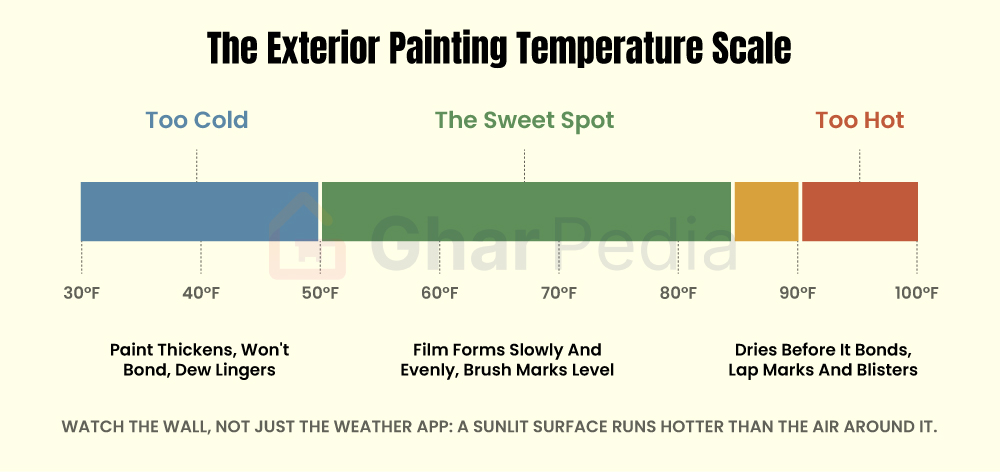
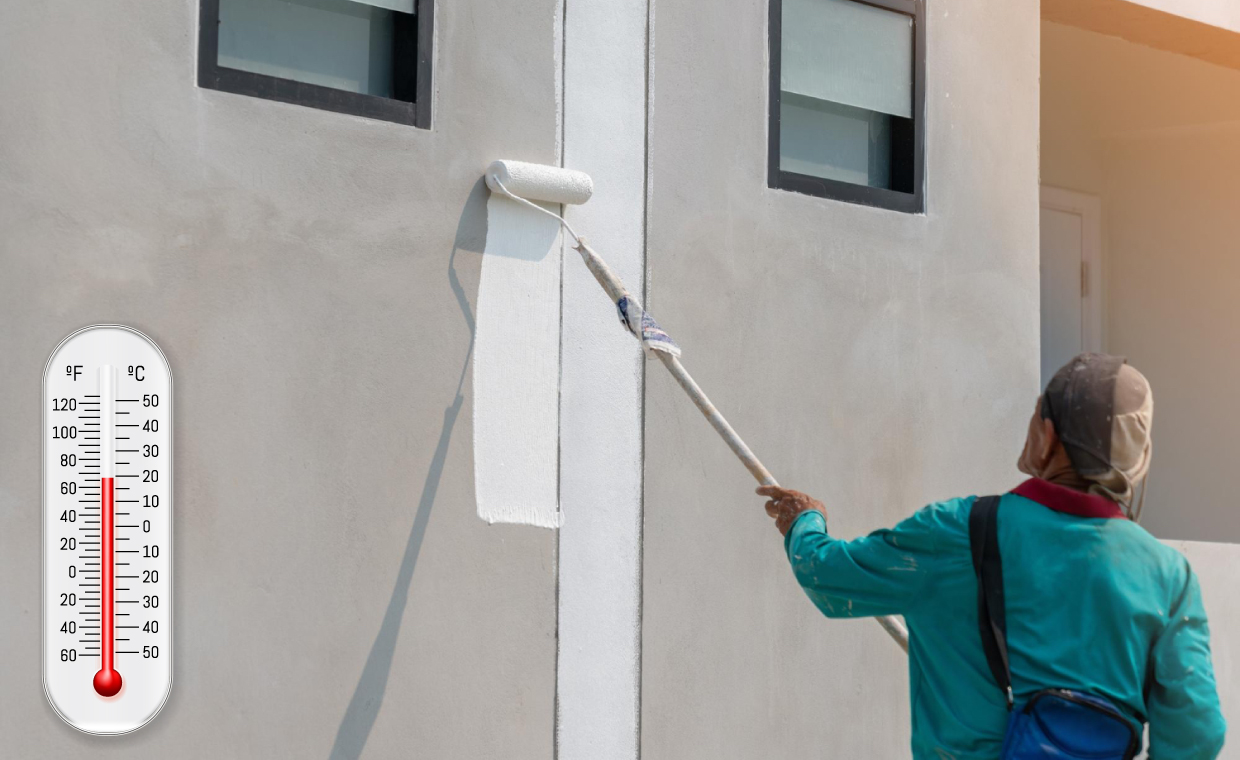
For the water-based paints most homes get today, pros put the ideal working range between about 50°F and 85°F. There’s a handy human test buried in that range: if you’d be comfortable working outside in a T-shirt without sweating or shivering, the paint’s probably comfortable too.
Inside that window, everything happens at the right speed. Water leaves the film gradually, the paint particles fuse into a continuous skin, and brush marks have time to flow out flat. It’s not that paint refuses to work outside the range. It just cuts corners you won’t see until later.
Too Hot: When Paint Dries Faster Than it Bonds
Heat sounds helpful. Faster drying, faster job, right? Except drying and bonding are two different things, and heat rushes the first at the expense of the second. Above 90°F or so, the water flashes off before the film can level and grip. That’s where lap marks come from, and blisters, and paint that goes chalky and brittle within a couple of years.
Now for the thermometer surprise. The number that matters isn’t the air temperature. It’s the wall temperature, and a wall sitting in direct sun runs hotter than air by a wide margin. Paint testers at Consumer Reports note that an 85-degree afternoon can push a sunlit wall past 100. Touch the siding with your palm. If it feels hot, it is, whatever the weather app says. This is why experienced painters chase the shade around a house all day instead of working straight through one side.
Too Cold: The Slow-Motion Failure
Cold fails quieter. Below about 50°F, water-based paint thickens up, spreads badly, and takes so long to set that dust, bugs, and moisture all get a vote in your finish. Worse, the film never forms properly, so the failure arrives months later as flaking and peeling, long after the receipt’s been tossed.
And it’s not just the daytime number. Paint keeps curing for days after it goes on, so overnight temperatures count too. Consumer Reports’ guidance is to apply at 50°F or warmer and make sure lows stay above freezing overnight for several days afterward. A warm Saturday followed by a frosty Sunday night can quietly undo the whole weekend. Cold-weather formulas exist that stretch the floor lower, but the can’s fine print is the law there, not the marketing on the front.
Temperature Has Accomplices
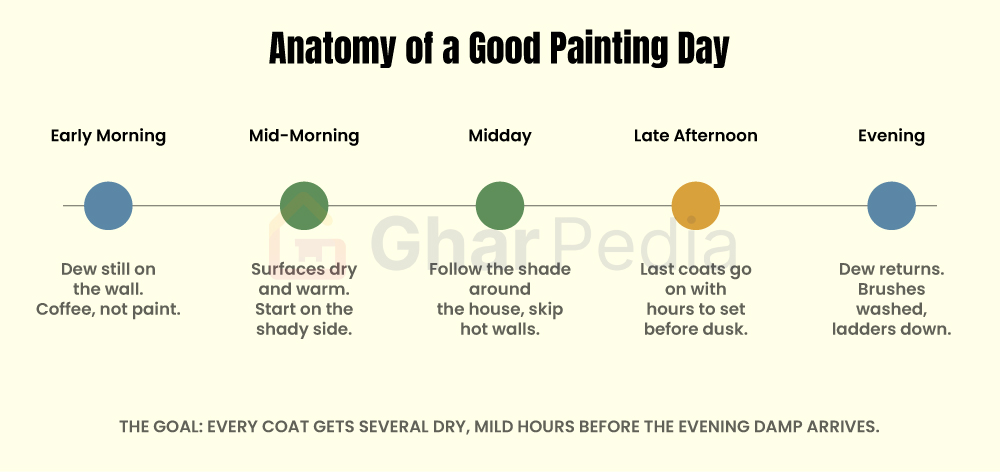
A perfect 70-degree day can still be a bad painting day. Humidity slows drying to a crawl and can leave streaky residue on the surface. Wind does the opposite, skinning the paint over too fast and throwing dust into the wet film for good measure. And rain is the obvious one: you want the surface fully dry before you start and a solid dry stretch after you finish, since a shower on uncured paint can spot it or wash it thin.
Dew is the sneaky one. It shows up on schedule every evening and sits on every surface every morning. Which is why the timing within a day matters as much as the day itself.
Putting it together
The rhythm of a good painting day is simple once you see it. Wait for the morning dew to burn off. Start on the shady side. Move around the house as the sun does, so you’re never brushing onto a baking wall. Then stop early enough that the final coat gets several mild, dry hours before the evening damp rolls back in.
Season-wise, that rhythm is easiest to find in late spring and early fall in most of the country, when days sit in the sweet spot and nights don’t crash. Summer and the shoulder months can absolutely work, but they demand more judgment about which wall to paint when. Reading a forecast is easy. Reading a wall takes practice, and knowing the best exterior painting temperature on any given hour of any given side of a house is honestly most of what separates a crew like Peach Painting from a weekend guess.
Paint is patient chemistry. Give it the temperature it wants and it’ll protect your house for a decade. Rush it or freeze it, and it keeps the grudge for years.
Also Read: How Exterior Coatings Extend Building Life
FAQs on Best Exterior Painting Temperatures
01. Can I paint outside at 40 degrees?
Only with a paint specifically formulated for low temperatures, and only if it stays above that paint’s stated minimum through the cure, nights included. With standard exterior paint, 40 degrees is asking for adhesion problems.
02. Is morning or afternoon better for painting?
Mid-morning through late afternoon, with adjustments. Start after the dew is gone, follow the shade, and stop while the last coat still has a few dry hours ahead of it. First light and dusk are the two worst times.
03. What if it rains right after I finish?
If the paint had a few hours to set, you may get away with some spotting that fades as it cures. If the rain hit fresh paint, expect streaks or thin patches and plan on a touch-up coat once everything’s bone dry.
04. Does humidity matter as much as temperature?
It’s the co-pilot. High humidity stretches drying times way out and can cause surface staining, while very dry, windy air rushes the film. Moderate humidity with still air is what you’re hoping for.
05. Should I trust the forecast or the wall?
Both, in that order. The forecast picks the day. The wall picks the hour. If the siding feels hot to your palm or damp to the touch, the weather app is outvoted.
Author & Expert Review
Written By:  Nidhi Patel | Civil Engineer & Content Writer

| Credentials: B.E. (Mahatma Gandhi Institute of Technical Education and Research Centre), Registered with Gujarat Technological University (GTU). Experience: Civil Engineer with 3+ years of content writing experience, currently writing blogs for Gharpedia, part of SDCPL. Expertise: Specializing in SEO-optimized blogs and long-form articles focused on home improvement, construction, interiors and architect topics. I create well-researched, reader-focused content that balances technical accuracy with clarity, making complex subjects easy to understand. Find her on: LinkedIn |
Verified By Expert:  Ravin Desai – Co Founder – Gharpedia | Co Founder – 1 MNT | Director – SDCPL

This article has been reviewed for technical accuracy by Ravin Desai, Co-Founder of Gharpedia and Director at Sthapati Designers & Consultants Pvt. Ltd. With a B.Tech. in Civil Engineering from VNIT Nagpur and an M.S. in Civil Engineering from Clemson University, USA, and over a decade of international and Indian experience in the construction and design consultancy sector, he ensures all technical content aligns with industry standards and best practices.
Find him on: LinkedIn