








Table of Contents
Quick Summary
- Understand how the 50% rule helps compare repair costs with the price of a new appliance.
- Learn why appliance age and expected lifespan can change the repair-or-replace decision.
- See which washer, dryer and refrigerator problems are generally worth repairing.
- Identify major failures, repeated breakdowns and safety concerns that may favour replacement.
- Follow practical tips for checking model numbers, choosing parts and preparing for DIY repairs.
- Find useful considerations when replacing an appliance, including measurements, haul-away services and energy efficiency.
Courtesy - Magnific
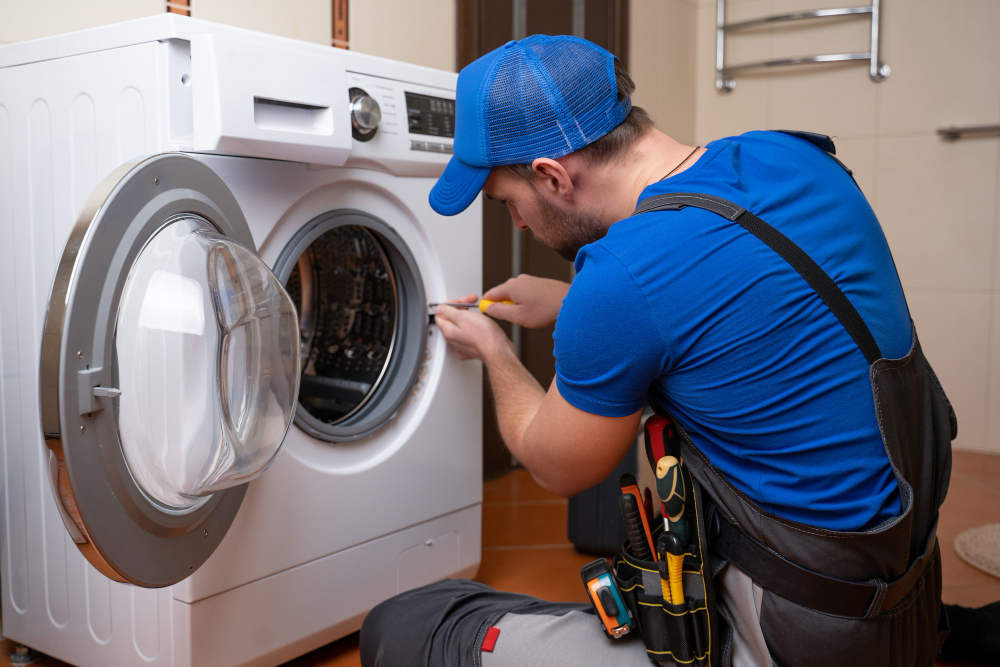
The washer stops mid-cycle with a tub full of water, and now you’re standing in the laundry room doing math in your head. Fix it? Buy a new one? The answer isn’t always obvious, and the wrong call either wastes a few hundred dollars on a machine that’s about to die anyway or sends a perfectly good one to the landfill.
There’s no perfect formula, but a few simple rules will get you to a smart decision most of the time.
The 50% Rule
This is the one you’ll hear most often. If the repair costs more than half the price of a comparable new appliance, replacing it usually makes more sense.
Say a new washer similar to yours runs $800. A $150 repair is an easy yes. A $450 repair is where you should start shopping.
It’s a good starting point, but it has one big blind spot: it ignores age. A $400 repair on a three-year-old refrigerator and a $400 repair on a 13-year-old refrigerator are not the same decision.
Add Age to The Math
Every appliance has a typical working life. Roughly speaking:
| Appliance | Typical lifespan |
| Refrigerator | 10 to 14 years |
| Washer | 10 to 13 years |
| Dryer | 12 to 14 years |
| Dishwasher | 9 to 10 years |
| Range | 13 to 17 years |
A good way to combine age and cost: if the appliance is past about two-thirds of its expected life, lower your threshold. At that point, even a 30 to 40 percent repair may not be worth it, because other parts are likely to start failing too.
Some technicians use another quick check. Multiply the repair cost by the appliance’s age in years. If the result is higher than the price of a new unit, replace it. A $120 repair on a 5-year-old dryer comes to 600, well under the price of a new dryer. The same repair on a 12-year-old dryer comes to 1,440, and that’s a different story.
The Repairs That Are Almost Always Worth It
Some failures sound scary but are cheap and quick to fix. If your appliance is otherwise in decent shape, these are usually worth doing:
- Washers: lid switches, door locks, drain pumps clogged with socks or coins, drive belts, and inlet valves.
- Dryers: thermal fuses, drive belts, idler pulleys, drum rollers, heating elements and gas igniters.
- Refrigerators: evaporator and condenser fan motors, defrost heaters and thermostats, door gaskets, water inlet valves and ice maker assemblies.
A lot of these are manageable DIY jobs if you can handle a nut driver and follow a video. The part itself is often the cheapest piece of the whole repair. On many jobs, a service call alone costs more than the part.
When Replacing Is the Smarter Move
Courtesy - Magnific
On the other side, some problems are a strong signal it’s time to shop:
- Sealed system failures on an older fridge. If the compressor has died or there’s a refrigerant leak, the repair requires a licensed tech and often costs a big share of a new unit’s price.
- Worn-out tub bearings on a front-load washer. You’ll hear a loud roar during the spin cycle. It’s a labor-heavy job, and on older machines it rarely pays off.
- Rust, cracks or water damage to the cabinet, tub or floor underneath.
- Repeated breakdowns. If this is the third repair in two years, the machine is telling you something.
- Safety concerns like scorch marks, burning smells or any gas smell. With gas, leave the house and call the utility first. Worry about the appliance later.
There’s also the energy side of the equation. A refrigerator from the early 2000s or earlier uses noticeably more electricity than a current ENERGY STAR model. If your old fridge needs a big repair, the savings on your power bill can help tip the scales toward replacement.
Washers, Dryers and Fridges: A Quick Decision Guide
Washer
Under 7 years old with a pump, switch or belt problem? Repair it. Over 10 years old with bearing noise, a leaking tub or a failed control board? Most people are better off replacing it. The gray area is a 7 to 10 year old machine with a board failure. That’s where price comparisons matter most.
Dryer
Dryers are some of the simplest appliances in the house, and most of their failures are inexpensive. Unless the drum is damaged or the cabinet is rusted out, a dryer with a heat, belt or roller problem is usually worth fixing, even at 10 years or more. One tip: clean the vent at the same time. A clogged vent is the most common reason heat parts fail in the first place.
Refrigerator
This is the one where the specific problem matters most. Fans, defrost parts, gaskets and valves are cheap, and replacing them can restore a fridge completely. A sealed system failure on a fridge older than about 8 to 10 years usually points toward replacement.
If You Decide to Repair It
Courtesy - Magnific
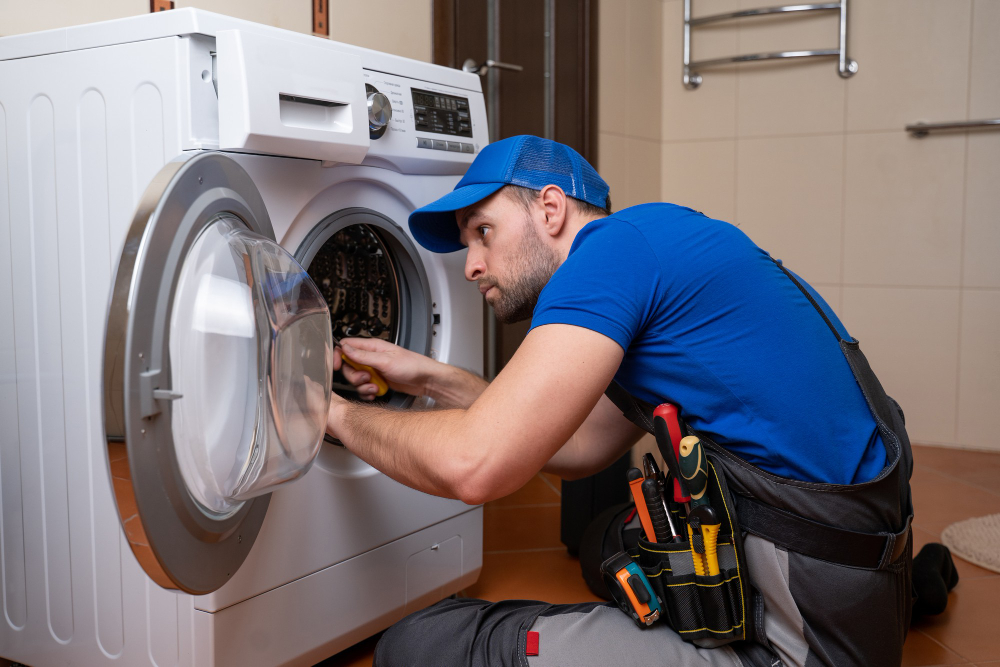
Start with the model number. On washers it’s usually under the lid or on the door frame. Dryers typically have it inside the door opening. Refrigerators keep it on a label inside the fresh food section. Take a clear photo of the tag.
Then track down the correct part for that exact model. You can search by model number at stores like Appliance Parts 4 All, which stocks genuine OEM parts for most major brands, then compare the part price against the cost of a new machine before you commit. Knowing the real number usually makes the decision for you.
A couple of tips before you pick up a screwdriver:
- Unplug the appliance. For gas dryers or ranges, shut off the gas valve too. For washers and refrigerators with water lines, close the supply valve.
- Take photos as you take things apart, especially of wire connections.
- Stick with OEM parts for anything that involves heat, gas or water. The fit and safety margins are just more predictable.
If You Decide to Replace It
Measure before you shop, including doorways and hallways, not just the space where the appliance goes. Ask about haul-away for the old unit, and check whether your utility offers rebates on ENERGY STAR models. A good local appliance store can help you compare options and get delivery and installation handled in one trip.
The Bottom Line
Use the 50% rule as a starting point, factor in age, and pay attention to what actually broke. A cheap part in an otherwise healthy machine is worth fixing. A major failure in an old one usually isn’t. Either way, making the call with real numbers beats guessing in the laundry room.
Also Read: Clear Ice Maker Maintenance for Optimal Performance
FAQs – Appliance Repair or Replace
01. Is it worth repairing a 10-year-old washing machine?
It depends on the problem. Pumps, lid switches and belts are usually worth fixing. Bearing failures, tub damage or repeated breakdowns on a 10-year-old washer usually mean it’s time to replace it.
02. How do I know if my refrigerator is worth fixing?
Look at the age and the type of failure. Fan motors, defrost parts and gaskets are cheap and worth replacing. Compressor or refrigerant problems on an older fridge usually aren’t.
03. What’s the most common appliance repair?
Across washers, dryers and fridges, the most common repairs involve wear parts like belts, pumps, switches, fans and heating components, which are also the cheapest to replace.
Courtesy - Featured Image(Magnific)
Author & Expert Review
Written & Verified By:  Farhan Shaikh – Senior Manager – Architect, SDCPL | Associate Member – IIA

| Credentials: Senior Manager – Architect at Sthapati Designers & Consultants Pvt. Ltd. and Associate Member of the Indian Institute of Architects (IIA). Experience: Architect with hands-on experience leading architectural and interior design projects at SDCPL, including architectural planning, interior design, project coordination, and sustainable design strategies. Expertise: Specializing in architectural planning, interior design, project coordination, and sustainable design. He reviews content to ensure it reflects practical design considerations, industry best practices, technical accuracy, and real-world applicability across architecture and interior spaces. Find him on: Linkedin |