




Table of Contents
Quick Summary
- Thousands of Indian households mistakenly confuse water hardness with Total Dissolved Solids (TDS) when treating borewell water.
- Hardness (calcium and magnesium) causes scaling on pipes and appliances, while TDS measures all dissolved salts and affects taste.
- A water softener uses ion exchange to stop scale across the entire home without lowering TDS.
- Conversely, Reverse Osmosis (RO) reduces TDS and hardness for drinking water at a single tap.
- Most borewell-supplied homes require a dual approach: a whole-house water softener at the main inlet and an RO system in the kitchen.
Every year, thousands of Indian households buy the wrong water treatment equipment. Not bad equipment — wrong equipment. They install an RO purifier hoping it will stop the white scaling on their taps, or they fit a softener expecting the drinking water to improve. Six months later the original problem is still there, and a fair amount of money has been spent solving something else.
The confusion comes down to two numbers that sound similar and are not: hardness and TDS. Understand the difference and the choice between a softener and an RO stops being a guess.
Hardness and TDS Measure Different Things
Courtesy - Magnific
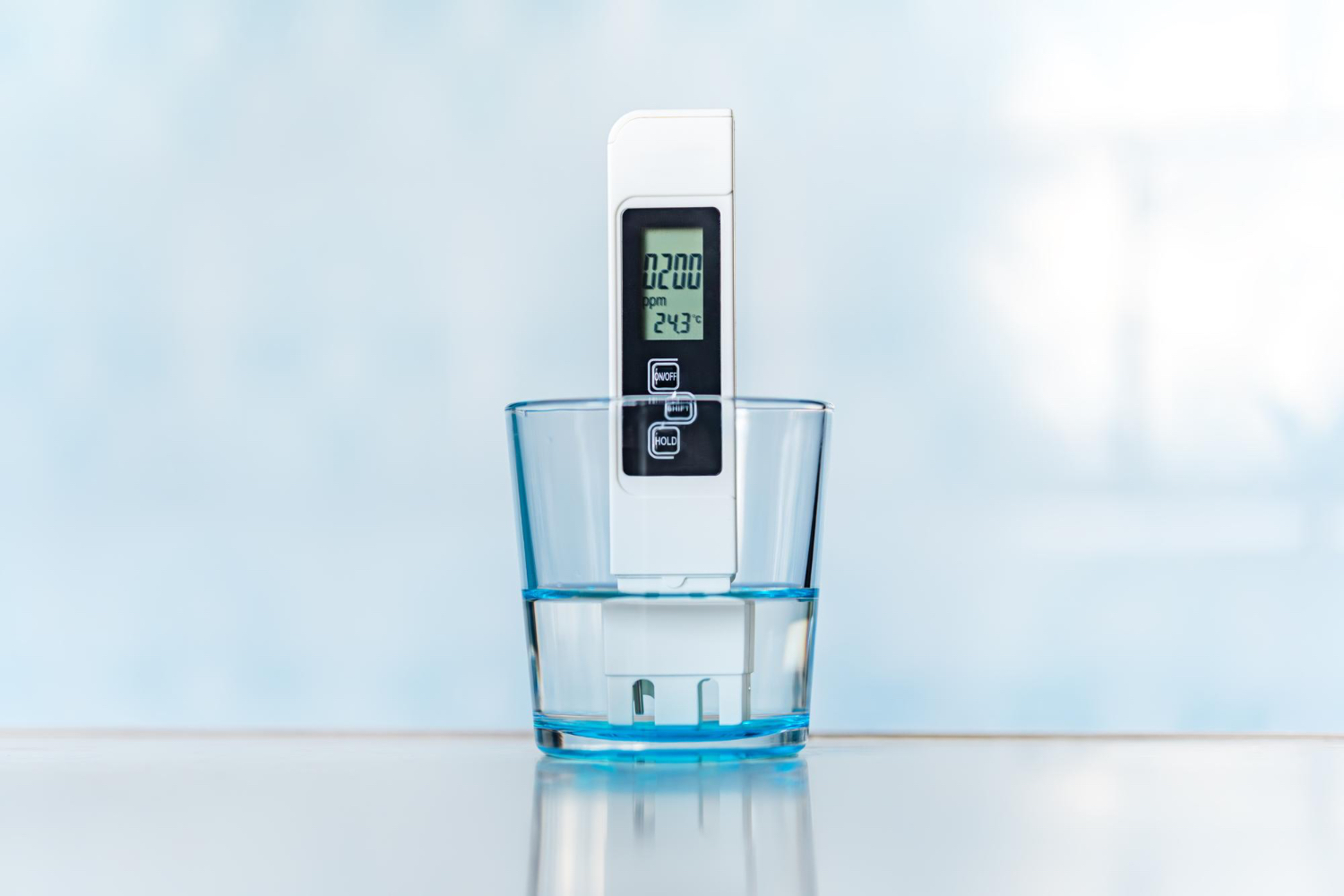
Total Dissolved Solids (TDS) measures everything dissolved in your water added together — calcium, magnesium, sodium, chlorides, sulphates, bicarbonates, and whatever else your borewell is pulling out of the ground. It is a total. It tells you how loaded the water is, not what it is loaded with.
Hardness measures only two of those: calcium and magnesium, expressed as mg/L of CaCO₃. These are the ions that form scale when water is heated or evaporates.
Hardness is therefore a component of TDS, not a synonym for it. Water can have high TDS and low hardness. It can also have moderate TDS and enough hardness to destroy a geyser in three years. The two problems announce themselves differently: hardness shows up as white chalky deposits on taps and shower glass, soap that will not lather, stiff clothes after washing, crackling geysers, and appliances failing early. High TDS is something you mostly taste — water that reads salty, bitter or metallic.
The Bureau of Indian Standards specification for drinking water, IS 10500:2012, sets an acceptable limit for total hardness of 200 mg/L as CaCO₃, with up to 600 mg/L treated as permissible only where no alternate source exists. For TDS, the acceptable limit is 500 mg/L.
Set that against reality. Borewell water in Bengaluru, Ahmedabad, Nagpur and large parts of Gujarat, Rajasthan, Telangana and Tamil Nadu routinely tests between 300 and 600 mg/L hardness, and TDS in Indian groundwater commonly runs from 300 to well over 1,200 ppm. Most borewell households are over the limit on both counts, which is precisely why the equipment question gets confusing.
What Each System Actually Does
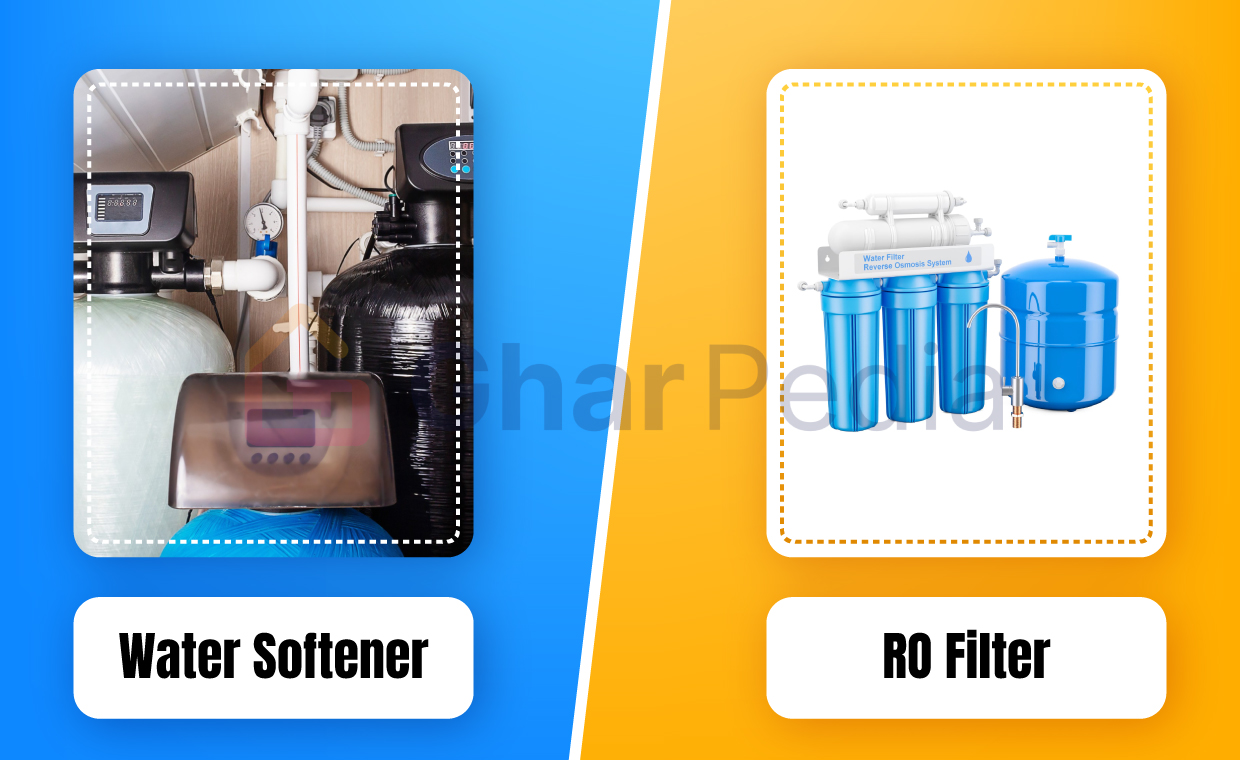
A water softener works by ion exchange. Water passes through a bed of resin beads carrying sodium ions. Calcium and magnesium have a stronger affinity for the resin, so they attach to it and release sodium into the water in their place. When the resin saturates, brine regenerates it and the cycle restarts.
Notice what happened. Calcium and magnesium left the water, sodium entered it, and one set of dissolved salts was swapped for another. Your TDS reading does not change.
This is the most misunderstood point in home water treatment, and it is worth stating with a number. Take groundwater at 800 ppm TDS and run it through a softener. The scaling stops, the geyser survives, the soap lathers, the tiles stay clean — and the TDS meter still reads roughly 800 ppm. Nothing was removed. Something was exchanged. If your goal was to stop scale, that is a complete success. If your goal was drinkable water, you have not moved.
Reverse osmosis pushes water through a semipermeable membrane under pressure, rejecting dissolved solids across the board — hardness ions, sodium, chlorides, sulphates, most of everything. TDS drops substantially, and because hardness is part of TDS, RO handles scale too.
Which is why people assume RO makes a softener unnecessary. At a single kitchen tap it often does. The trouble is coverage. An RO unit purifies a few litres per hour at one point of use, and cannot treat the water reaching your geyser, washing machine, bathrooms and overhead tank. Scaling continues everywhere except the kitchen — and hard feed water shortens the life of the RO membrane itself.
Choosing Between Them
| Your situation | What you need |
| Scale on taps and fittings, poor lathering, geyser trouble — TDS within limits | Softener at the point of entry |
| Water tastes salty or bitter, TDS above 500 — but no visible scaling | RO at the drinking water point |
| Both scaling and high TDS (most Indian borewell homes) | Softener for the whole house, RO for drinking |
| Municipal supply, TDS under 300, no scaling complaints | Neither — basic filtration is usually enough |
| Very high iron or turbidity in the borewell | Pre-filtration first, before either one |
That last row matters more than its position suggests. Iron and suspended solids foul softener resin and RO membranes alike. If your borewell water leaves reddish-brown stains or looks cloudy when first drawn, sediment and iron removal has to come first, or you will be replacing expensive media far too often.
Sizing follows the same logic. Softener capacity depends on daily consumption, raw water hardness, and how often you are willing to regenerate. Higher hardness exhausts the resin faster, which means either a larger vessel or more frequent regeneration and more salt. A unit sized for a family of four at 250 mg/L hardness will be undersized at 550 mg/L, even though the household is identical. If a vendor quotes you a softener without asking for your hardness figure, they have not sized it — they have picked one off a shelf.
The Same Decision at Commercial Scale
Apartment societies, hotels, hospitals and factories face this question in exactly the same form. The flow rates and tolerances change; the reasoning does not.
In commercial specification this is treated as a routing decision rather than a product choice. Hiju’s water treatment solutions documentation sets the boundary out explicitly: if the only objective is preventing scale on heat transfer surfaces and the total dissolved load is acceptable for the application, softening alone is sufficient. Once a defined TDS ceiling enters the requirement — drinking water, food processing, boiler feed at medium to high pressure — a membrane stage has to follow it.
The thresholds there are far tighter than domestic ones. Softener outlet hardness for commercial hot water and steam circuits is typically specified below 1 ppm as CaCO₃, against a domestic target most households would be delighted to hit at 50. But the underlying question is identical to the one in your bathroom: is this a scale problem, a dissolved solids problem, or both?
Test Before You Buy Anything
A TDS pen costs a few hundred rupees and takes five seconds. It is useful and it is not sufficient, because it will not tell you your hardness — the number that actually decides whether you need a softener at all.
Get a laboratory analysis, or at minimum use a hardness test kit alongside the TDS meter, and ask for total hardness as mg/L CaCO₃, TDS in ppm, pH, iron in mg/L, turbidity in NTU, and chlorides if the water tastes salty. Borewell chemistry also shifts seasonally, so where possible test once before and once after the monsoon rather than trusting a single reading taken in April.
Then the decision writes itself. A softener removes hardness and leaves TDS where it was. An RO reduces TDS, including hardness, but only where it is installed. Most Indian homes on borewell water need both, in different places — the softener on the main inlet protecting plumbing, geyser and appliances, the RO at the kitchen tap for drinking and cooking.
Also Read: What is the Difference Between RO and UV Water Purifiers?
FAQs on Water Softener or RO
01. What is the difference between TDS and water hardness?
TDS measures the combined total of all minerals and salts dissolved in water. Hardness specifically measures calcium and magnesium levels, which cause chalky white scaling on taps and ruin heating appliances.
02. Does a water softener lower the TDS of my water?
No. A water softener exchanges calcium and magnesium ions for sodium ions. While it successfully eliminates scale build-up, the total amount of dissolved solids remains roughly the same.
03. Why isn’t a kitchen RO purifier enough for the whole house?
RO purifiers are point-of-use systems designed to purify small quantities of drinking water. They cannot handle the high volume needed for showers, washing machines, and geysers, leaving the rest of your home unprotected from scale damage.
04. What should I do if my borewell water has both high TDS and high hardness?
You need a combined solution. Install a whole-house water softener at the main inlet to protect your plumbing and appliances, and an RO purifier at the kitchen tap for safe, good-tasting drinking water.
05. Should I test my borewell water before buying a purifier or softener?
Yes. A simple TDS meter only shows total load, not hardness. Get a proper laboratory test to check hardness (mg/L CaCO₃), TDS, pH, iron, and turbidity before purchasing equipment to ensure correct sizing and filtering.
Courtesy - Featured Image(Magnific - Image 1, 2)
Author & Expert Review
Written By:  Nidhi Patel | Civil Engineer & Content Writer

| Credentials: B.E. (Mahatma Gandhi Institute of Technical Education and Research Centre), Registered with Gujarat Technological University (GTU). Experience: Civil Engineer with 3+ years of content writing experience, currently writing blogs for Gharpedia, part of SDCPL. Expertise: Specializing in SEO-optimized blogs and long-form articles focused on home improvement, construction, interiors and architect topics. I create well-researched, reader-focused content that balances technical accuracy with clarity, making complex subjects easy to understand. Find her on: LinkedIn |
Verified By Expert: Avni Desai Environmental Engineer, SDCPL | M.E. (Environmental Engineering)
 Avni Desai Environmental Engineer,
 This article has been reviewed for environmental, MEP, and building services accuracy by Avni Desai, an Environmental Engineer at Sthapati Designers & Consultants Pvt. Ltd. (SDCPL). With over 8 years of experience in water supply, wastewater management, infrastructure design, and building services, she brings practical expertise in MEP services, sustainable solutions, design planning, and on-site practices. Her professional services include planning and design of water supply systems, sewage and wastewater treatment systems (STP/WTP), drainage, rainwater harvesting, and other sustainable building services. Her review ensures the content aligns with environmental standards, efficient services planning, and real-world applicability.
Find her on: LinkedIn