





Table of Contents
Quick Summary
- See how a simple wheel stopper can prevent common parking knocks at home.
- Learn how to position the stop based on your car, wall and available clearance.
- Compare short rubber stops with larger parking blocks for compact spaces.
- Find out why height, material, reflective strips and fixing method matter.
- Check walkways, doors, drains and slopes before fixing a stopper in place.
- Understand the precautions needed when drilling into tiled or concrete floors.
- Consider shared parking rules before making permanent changes.
- Use practical measurements to create a consistent parking position every day.
Courtesy - Magnific
Home parking spaces are often tight. Garages are narrow, car porches are short, stilt parking bays sit tightly between columns, and many families fit two cars, a scooter and a row of plants into the same space. Drive in a few centimetres too far and the bumper touches the wall. Reverse in without looking and the back of the car hits the garage door.
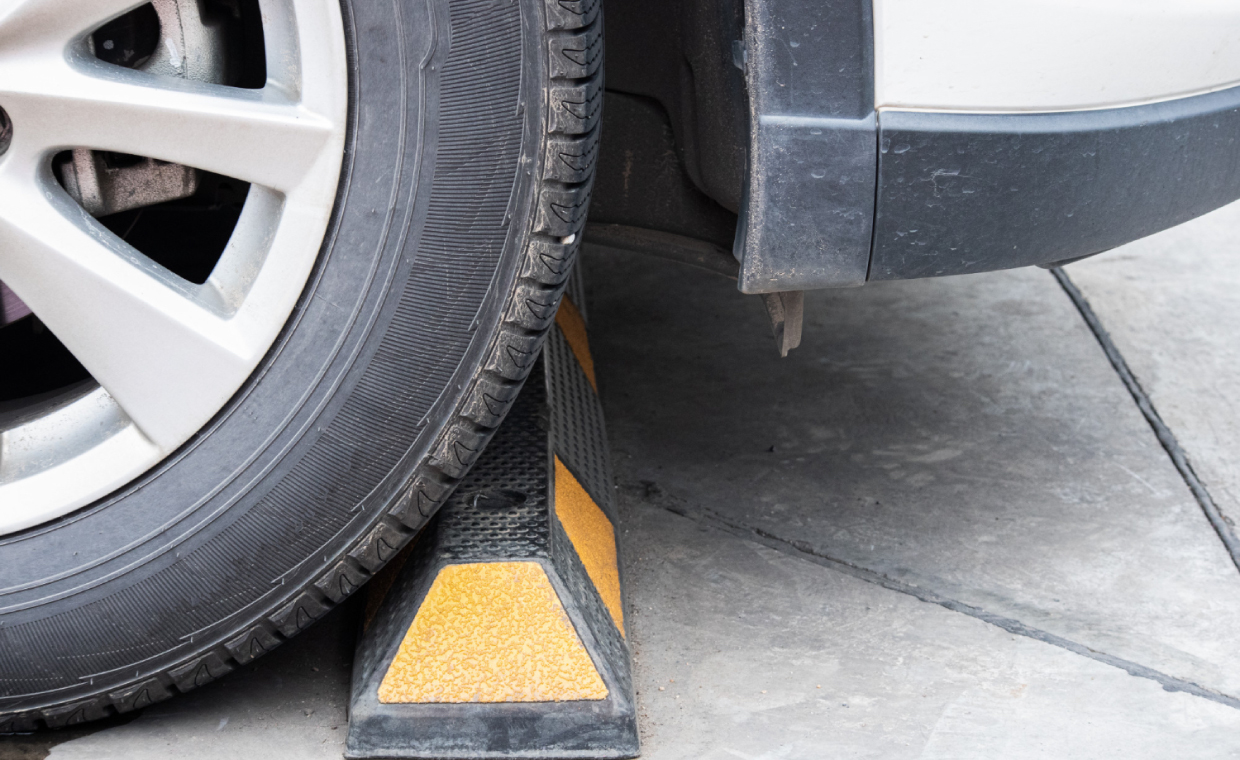
Each knock means a repair, and over time the cost grows. A wheel stop is a simple way to prevent this. It is a low block fixed to the floor, at the point where the tyre should stop.
Preventing Cars from Hitting Walls and Garage Doors
From the driver’s seat, it is hard to judge where the front or back of the car ends. Parking sensors help, but not every car has them, and not every driver trusts the beeping. With a wheel stop, you feel the tyre touch it and you know it is time to stop.
The easiest way to find the right spot is to test it with your own car. Ask someone in the family to stand beside the car and guide you in slowly. Stop when the bumper is close to the wall but there is still room to walk in front of it. Then mark the front of each tyre on the floor with chalk. That is where the wheel stop goes. If you usually reverse in, do the same with the back of the car.
A wheel stop also protects other things in the parking space, such as the electricity meter, a water tank, storage shelves, a shoe rack or pots of plants.
In homes with two cars, the position should suit the car that actually uses that space. If you change cars later, the stop can be moved, as long as it was bolted down rather than glued.
Choosing Wheel Stops for Small Parking Spaces
Courtesy - Magnific
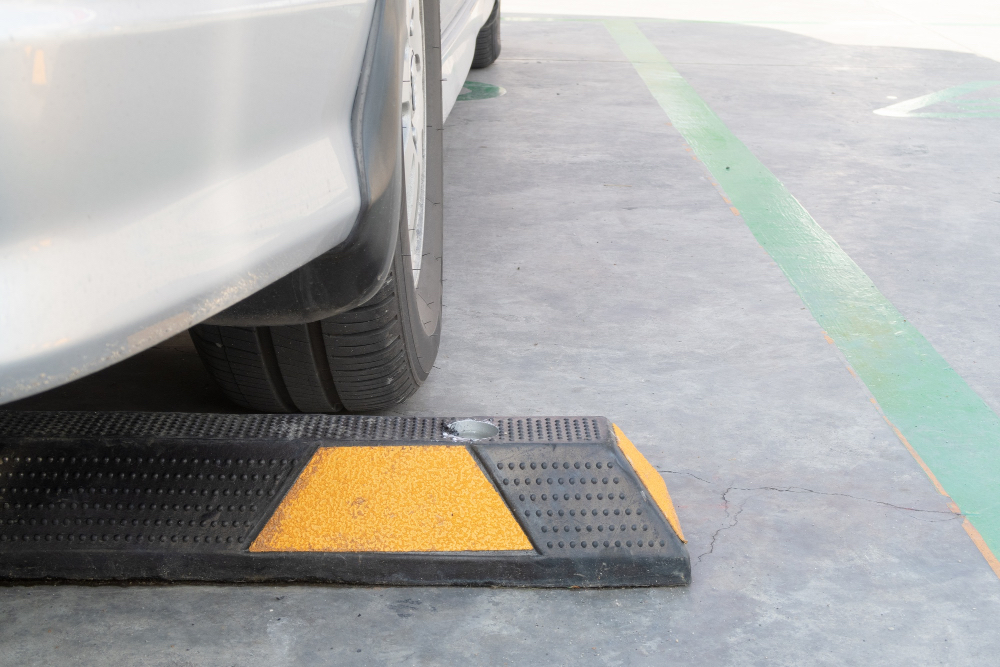
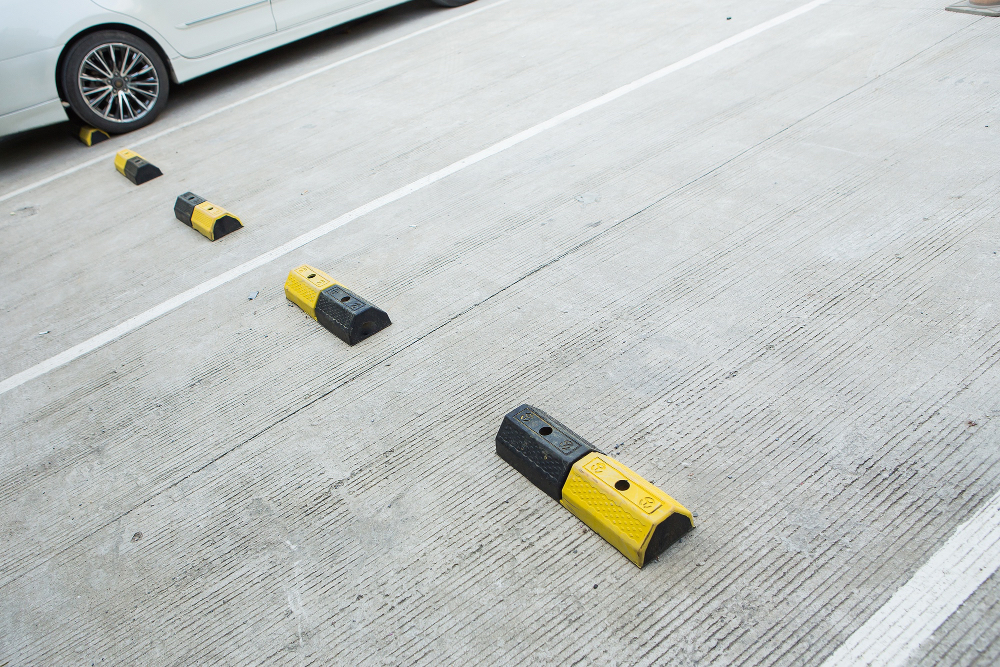
The wheel stops in shopping centre car parks are often 1.6 to 1.8 metres long, which is too much for most home garages. A short stop of about 55 cm, one for each wheel, usually works better. At around 4 to 5 kg each, they are easy to carry, and the gap between them leaves room to walk around the car.
Also think about height. Most wheel stops are about 10 cm high. If your car sits low at the front, as many hatchbacks and sedans do, a lower model of about 8 cm is less likely to scrape the bumper.
Then choose the material. The concrete stops used in big car parks are too heavy for most homes. Many home stops are now made from a mix of rubber and plastic. This is quiet when the tyre touches it, which matters if the garage is next to a bedroom, and it sits well on floors that are not perfectly flat. Look for a stop where the colour is part of the material rather than painted on, so it does not wear off. A textured top is also less slippery if someone steps on it in the rain.
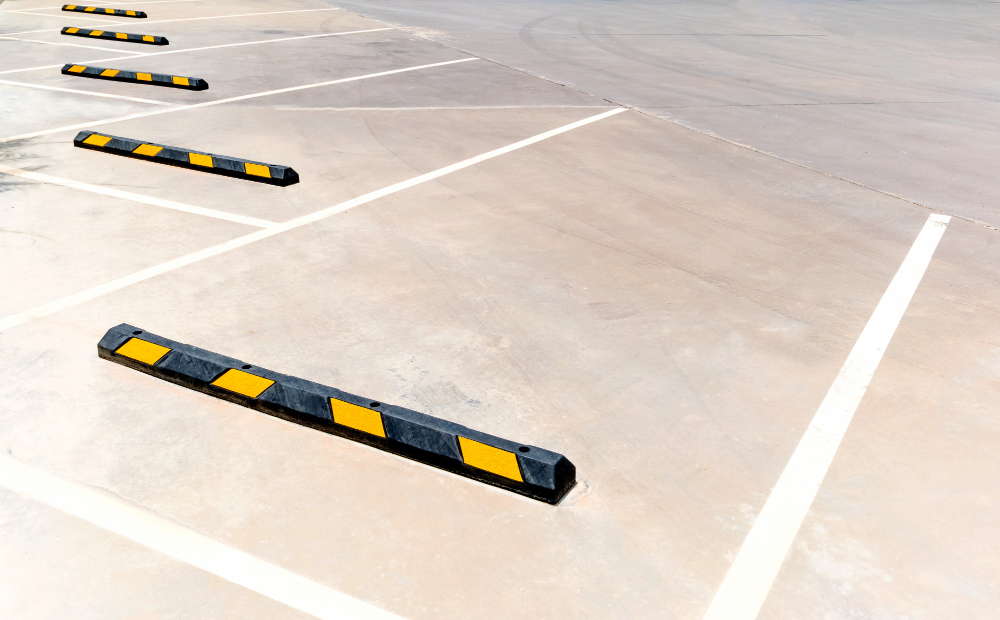
At night, with the porch light off, a black stop on a grey floor is almost invisible. A stop with reflective strips shows up in the car’s headlights, and family members can see it when they walk out to the car. The strips are usually yellow, but white or blue are also available if yellow does not suit the house.
Many garage wheel stops are designed for homes like these. They are shorter and lower than car park models, and come with fixings for a home floor.
Placing Wheel Stops Without Blocking Walkways
At home, the parking space is also used for other things. People walk through it to reach the front door or the back of the house. Children ride bicycles in it. Someone has to get the dustbin out every morning. If a wheel stop is in the wrong place, people will trip over it.
Before fixing anything, leave the car parked on the chalk marks and walk around it. Check:
• Is there still enough space in front of the car to walk past comfortably?
• Is the stop away from places where a door, gate or garage door opens?
• Is it clear of steps, drains and the edge of the porch?
One short stop per wheel, rather than one long block, keeps the space between the wheels free for walking. A light near the parking space also helps, so nobody trips over the stop in the dark.
Checks Before Installing Wheel Stops
Courtesy - Magnific
A few checks before fitting will help you avoid problems later.
- Check the floor. Tiles can crack when drilled, so use the right drill bit and go slowly, or ask a contractor.
- Check what is under the floor. Water pipes and electric cables often run under porches and garages, especially near walls, meters and taps.
- Check where rainwater goes. Porches and driveways usually slope towards a drain or the road. A stop placed across that slope can leave a puddle next to the car door, so leave a gap for the water to run through.
- Measure the car that will park there, including its overhang and ground clearance. If you plan to change cars soon, think about the next one too.
- Ask for permission if you need it. In apartment buildings and housing societies, parking areas such as stilt parking are often shared, so speak to the society or building management before drilling.
- Make sure the fixings suit your floor. Good wheel stops come pre-drilled, with galvanised screws and plastic anchors for concrete or asphalt. Galvanised steel does not rust easily, which matters during the monsoon.
Once these points are clear, fitting the stops is usually a quick job. After that, the car stops in the same place every day.
Also Read: Understanding Your Options for a Garage Door
FAQs – Wheel Stopper
1. What is a wheel stopper used for at home?
A wheel stopper helps limit how far a car can move into a parking space. It can prevent the vehicle from hitting walls, garage doors, pillars, shelves or other objects.
2. Is a rubber wheel stopper suitable for home parking?
Yes. Rubber wheel stoppers are commonly used in garages, basement parking and residential parking areas because they are relatively lightweight and can absorb tyre contact without the hardness of concrete.
3. How do I know where to install a wheel stopper?
Park the car in the desired position and maintain enough clearance from the wall or other obstruction. Mark the tyre positions and install the stopper so the wheels contact it before the vehicle reaches the obstruction.
4. Can wheel stoppers damage a tiled parking floor?
Drilling directly into tiles can cause cracking or chipping. Check the floor construction and use suitable drilling and fixing methods. Where necessary, get advice from a qualified contractor before installation.
5. Are wheel stoppers suitable for apartment or society parking?
They can be useful, but permission may be required if the parking space is shared or managed by a housing society. Check the society’s rules before drilling or permanently fixing a stopper.
Courtesy - Featured Image(Magnific)
Author & Expert Review
Written & Verified By :  Ravin Desai – Co Founder – Gharpedia | Co Founder – 1 MNT | Director – SDCPL

| Credentials: B.Tech. in Civil Engineering from VNIT Nagpur and M.S. in Civil Engineering from Clemson University, USA. Co-Founder of Gharpedia and Director at Sthapati Designers & Consultants Pvt. Ltd.. Experience: Civil engineering professional with over a decade of international and Indian experience in the construction and design consultancy sector, with expertise in technical review and industry practices. Expertise: Specializes in reviewing technical content related to civil engineering, construction, design consultancy, materials, and industry practices. He ensures content is technically accurate, aligned with industry standards, and reflects practical construction and design best practices. Find him on: LinkedIn |