





Table of Contents
Quick Summary
- How to cool a garage effectively starts with reducing heat gain through the garage door, ceiling, and air leaks.
- Insulating the garage door can help limit heat entering through the largest exposed surface.
- Ceiling insulation and weatherstripping can further improve the garage’s thermal performance.
- Fans can improve comfort by circulating air, but they do not actually lower the garage temperature.
- Portable, window, and mini-split ACs offer different cooling solutions depending on garage size and usage.
- If you regularly use your garage as a workshop, gym, or workspace, a dedicated mini-split system may be worth considering.
- Proper HVAC sizing and installation are important to avoid inefficient cooling and excess humidity.
Courtesy - Magnific
Open the garage door on a July afternoon and the heat hits you like you opened an oven. Garages bake in the sun all day, most have little or no insulation, and the big metal door acts like a giant radiator. A garage sitting at 105°F is unusable for anything beyond parking, and some of that heat leaks into the rooms next door.
You can fix it. But the right fix depends on what you do in the space, and a bit of cheap prep work can keep you from buying more cooling than you need.
How Do You Use Your Garage?

Courtesy - Magnific
If your garage is strictly for parking and storage, permanent air conditioning is hard to justify. You open that big door several times a day, and whatever cool air you’ve built up escapes right along with the car.
But garages have become some of the hardest-working rooms in the house. Workshops, home gyms, hobby benches, even makeshift offices: if you spend real hours out there every week, the math changes. A space you use daily deserves real climate control, not a box fan and optimism.
That’s the situation where a dedicated garage mini split makes sense: the space gets its own heating and cooling, with its own temperature setting, separate from the rest of the house. You condition the garage when you’re in it and don’t pay to cool it when you’re not.
One safety note before we go further, because people gloss over it: air conditioning and ventilation are not the same thing. An AC cools the air already in the room. It does not bring in fresh air or remove fumes. If you run vehicles, store gasoline, or work with paint and solvents out there, you need a ventilation plan too. No air conditioner protects you from carbon monoxide.
Your Main Cooling Options

Courtesy - Magnific
A ceiling fan or a good shop fan makes you feel cooler by moving air across your skin, and it costs almost nothing to run. It won’t lower the temperature, though. A fan in a 100°F garage pushes hot air around. Fans work well alongside real cooling; on their own, they lose.
Portable and window units can take the edge off a small, well-sealed garage, and the upfront cost is low. The catches: window units need a suitable window (many garages don’t have one), portable units eat floor space and need an exhaust hose, and both tend to give up once the heat gets serious. Fine for occasional use in a mild climate. Frustrating as a daily solution through a Texas summer. Neither one heats, either, which starts to matter once February rolls around.
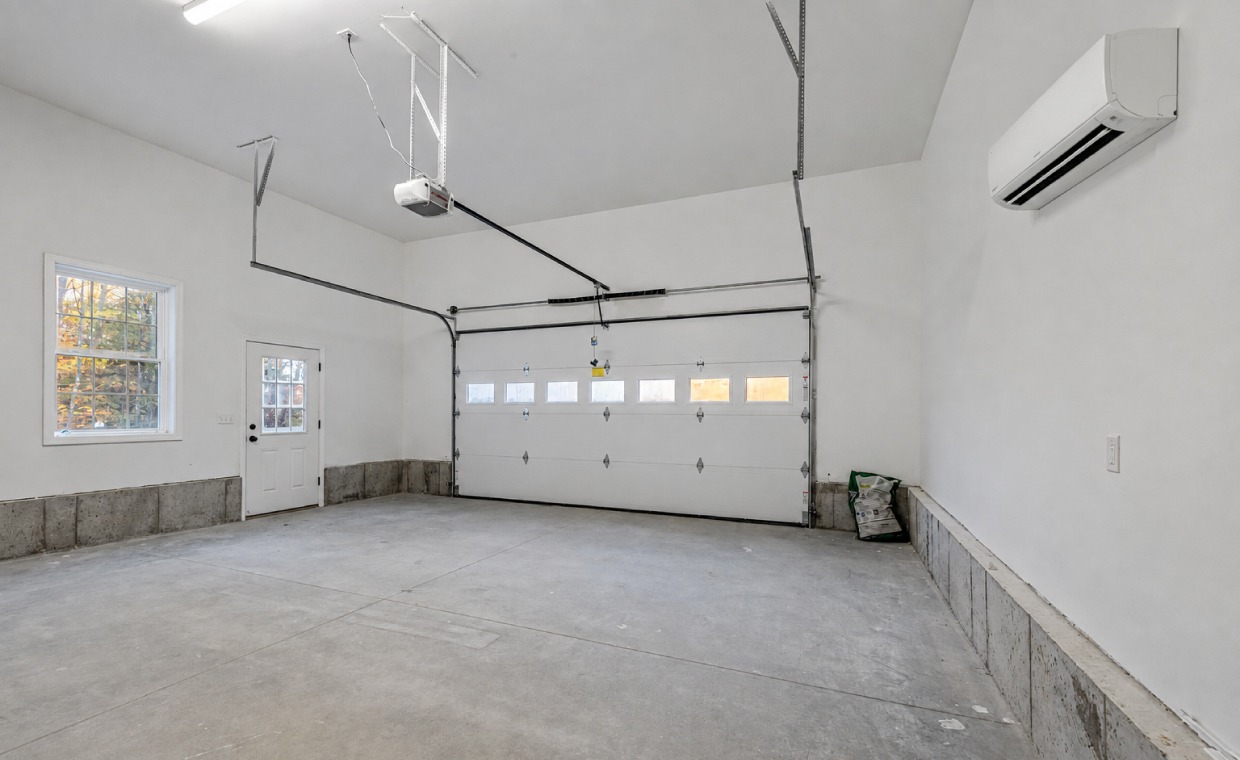
For a garage that sees regular use, ductless is usually the sweet spot. A mini split AC puts one indoor unit on the garage wall, connected to a compact outdoor condenser through a small wall penetration. The house’s central system stays out of it, and you keep your windows. Most units heat as well as cool, so the garage stays usable in January too. The tradeoff is a higher upfront cost and a proper installation.
Whatever you end up buying, do the cheap prep work first. It shrinks the size, and the price, of the unit you need.
Cut the Heat Gain First
Every bit of heat you keep out of the garage is cooling capacity you don’t have to pay for, upfront or on your electric bill. Three fixes, in order of payoff:
- Insulate the garage door first. It’s the biggest, thinnest surface in the house, it bakes in direct sun, and insulation kits are cheap.
- Then look above the ceiling. If there’s an attic over the garage, summer heat pours down through an uninsulated ceiling for hours after sunset. Insulating up top pays off in winter too.
- Finally, the leaks. Weatherstripping on the entry door, a fresh bottom seal on the garage door, caulk on the obvious gaps. Not glamorous. Very effective.
Sizing the Unit
You’ll find plenty of charts online matching BTUs to square footage, and they’re okay as a rough ballpark. But two garages with identical dimensions can need very different amounts of cooling. A detached garage in Seattle and an attached one with a west-facing door in Phoenix live in different worlds. Ceiling height, insulation, windows, heat radiating off a car that pulled in an hour ago, and whatever equipment you’re running out there all push the number around.
Resist the urge to oversize to be safe. An oversized unit cools the air so fast it shuts off before it can pull the humidity out, leaving the space cold and clammy. Many newer systems use inverter compressors that throttle their output up and down, which softens the problem. Matching the unit to the real load is still the goal. If you’re torn between sizes, a load calculation from an HVAC pro costs little and settles it. Guessing, in either direction, is what gets expensive.
Installation Details to Sort Out Early
A few decisions to make before the installer shows up:
- Put the indoor unit high on a wall with clear airflow, away from workbenches, shelving, and the travel path of the garage door.
- Decide where the condensate drains. Cooling produces water, and it needs a safe route outside.
- Check your panel’s spare capacity and what voltage the unit needs before you buy, not after.
- Give the outdoor unit breathing room and service access. Don’t box it in behind the trash cans.
So, Is It Worth It?
Parking only? Probably not. Weekend projects a few times a month? Start with the insulation and a fan and see how far that gets you. But if your garage is a daily gym, workshop, or workspace, dedicated heating and cooling starts earning its keep. It turns square footage you already own into a room you use. Fix the heat gain first, size the equipment to the real load, and the hottest room on your property becomes one of the most comfortable.
Also Read: 7 Steps for Building a Beautiful Garage
FAQs on How to Cool a Garage
1. How to cool a garage without AC?
You can improve garage comfort by insulating the garage door and ceiling, sealing air leaks, and using a ceiling or shop fan to circulate air.
2. Does insulating a garage door help keep it cool?
Yes. Garage-door insulation can reduce heat entering through the large door surface, particularly when it is exposed to direct sunlight.
3. Can a fan actually cool a garage?
A fan does not lower the garage’s actual temperature. It improves comfort by moving air across your skin, so it works best alongside other cooling measures.
4. What is the best AC for a frequently used garage?
For a garage that is regularly used as a workshop, gym, or workspace, a ductless mini-split can be a practical option because it provides dedicated heating and cooling.
5. Should you oversize an AC unit for a garage?
No. An oversized unit may cool the air too quickly without adequately removing humidity. A load calculation can help determine the appropriate unit size.
Courtesy - Featured Image(Magnific)
Author & Expert Review
Written By:  Nidhi Patel | Civil Engineer & Content Writer

| Credentials: B.E. (Mahatma Gandhi Institute of Technical Education and Research Centre), Registered with Gujarat Technological University (GTU). Experience: Civil Engineer with 3+ years of content writing experience, currently writing blogs for Gharpedia, part of SDCPL. Expertise: Specializing in SEO-optimized blogs and long-form articles focused on home improvement, construction, interiors and architect topics. I create well-researched, reader-focused content that balances technical accuracy with clarity, making complex subjects easy to understand. Find her on: LinkedIn |
Verified By Expert: Farhan Shaikh – Senior Manager – Architect, SDCPL | Associate Member – IIA

This article has been reviewed for architectural and interior design accuracy by Farhan Shaikh, Senior Manager – Architect at Sthapati Designers & Consultants Pvt. Ltd. As the lead for all architectural and interior projects at SDCPL and an Associate Member of the Indian Institute of Architects (IIA), he brings hands-on experience in architectural planning, interior design, project coordination, and sustainable strategies. His review ensures the content reflects practical design considerations, industry best practices, and real-world applicability across both architecture and interior spaces.
Find him on : Linkedin