






Table of Contents
Quick Summary
- Measure the floor or wall area in square metres. Length times width, room by room, then add the areas together.
- Add a wastage allowance on top. Around 10% for a straight lay, rising to 15–20% for a diagonal, herringbone or crazy-pave lay.
- Round the total up to whole boxes, because you buy tiles by the box, not the tile.
- Order the full quantity plus a few spares in one purchase, so every box carries the same batch code.
Courtesy - Magnific
The tiler is two-thirds of the way across the living room floor and there are three boxes left on the trolley. The lay is a 45-degree diagonal, and the cuts around the hearth swallowed more tile than anyone budgeted for. Now the shop says that shade is on a fresh batch. Most people meet the real rules of tile ordering right here, at the worst possible moment to learn them.
Working out how many tiles to buy is a different job from measuring your floor. You measure the area. Then you add for the cuts your lay pattern forces, and buy the whole lot at once so the colour holds. Get those steps in order and you sidestep the two failures that stop a job dead: running short mid-lay, and matching a second delivery that never quite matches.
Measure The Area, Not the Room
Courtesy - Magnific
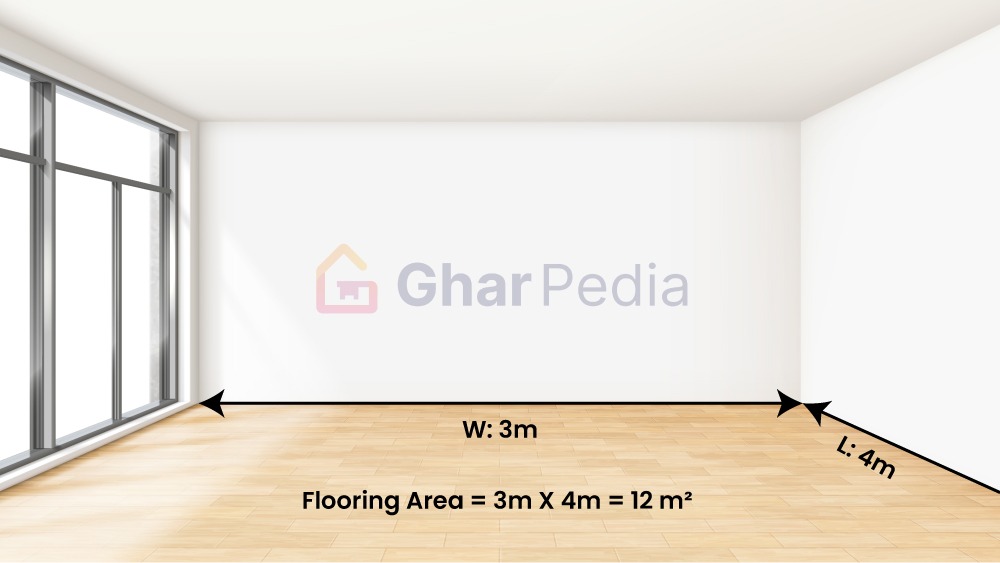
Start with the tiled surface, not the floor plan. Measure length and width in metres and multiply for the square metre figure. Do this per room or per wall rather than treating an L-shaped space as one rectangle. Split awkward shapes into rectangles you can measure cleanly, then add them.
A worked example makes the units clear. A room 4 m by 3 m is 12 m². Lay 600 by 600 mm porcelain and each tile covers 0.36 m², so the bare area needs about 34 tiles. Boxes of that size usually hold four tiles and cover roughly 1.44 m², which puts you at nine boxes before any allowance for waste. You never buy 34 loose tiles anyway, so it is the box coverage printed on the range that governs the order.
Deduct almost nothing for fixed objects. A kitchen island or a hearth is worth subtracting, but skip the fiddly deductions for a toilet pan or a vanity. The tile that would have sat under them becomes a cut anyway, and you want that material on site.
The Wastage Buffer Depends on Your Lay Pattern
The lay pattern decides how much tile you cut and cannot reuse. A straight grid running parallel to the walls wastes the least: most cuts happen at the perimeter, and the offcut from one edge often starts the opposite edge. Around 10% on top of your measured area covers it.
Turn the grid to 45 degrees and the maths changes. Every perimeter tile becomes a triangle cut, and offcuts rarely serve twice, so a diagonal lay pushes you to 15% or more. Herringbone is hungrier again, because the pattern ends on an angle against every wall and each closing tile is a cut. Crazy-pave, where irregular pieces are fitted by eye, wastes the most of any common lay, so treat 20% as a floor rather than a ceiling.
Two other things lift the buffer. A small or broken-up space, like a bathroom full of niches and a shower hob, has a high ratio of edge to field, so more of every box ends up as offcut. Large-format tiles, say 1200 by 600 mm, give you fewer chances to reuse a cut, so round waste up rather than down. When you sit between two figures, take the higher one: a spare box only costs you garage space, whereas running short stops the tiler mid-floor.
Buy From One Batch, And Buy More Than You Measure

Courtesy - Magnific
Tiles are fired in batches, and shade and calibre can drift slightly from one run to the next, so a floor laid from two separate deliveries can show a visible seam under raking light. Once you have your area and its wastage allowance, order the whole amount, spares included, in a single purchase. That way every box comes off the same batch code.
This is why where you buy matters as much as how much. It pays to buy from a supplier that holds deep, consistent stock: Australian tile retailer The tile collective runs showrooms across Brisbane and the Gold Coast alongside its online range, so you can confirm a batch and check the quantity available before ordering full boxes in one go. Its stores in Herston, Underwood, Labrador and Burleigh, plus a factory outlet at Woodridge, span floor, wall, bathroom, outdoor, pool, mosaic, subway and stone-look ranges priced per square metre, which means the full order plus wastage usually comes off one batch rather than being scraped together from two.
Keep half a box back once the job is done. A dropped saucepan chips a floor tile, or a bathroom leak lifts two, and a spare from the original batch fixes it invisibly. Buy a close-enough tile two years later and the patch shows to everyone who looks.
Check The Batch Code Before the Tiler Starts

Courtesy - Magnific
When the pallet arrives, read the batch and shade numbers on the box ends before a single tile is opened. They should all match. If one box is odd, set it aside and call the supplier while the rest of the order is untouched, because a mismatched box is easy to swap on day one and impossible to hide once it is grouted into the middle of a floor.
Confirm calibre too. Calibre is the exact fired size within a nominal dimension, and mixing calibres gives uneven grout lines even when the colour matches. A single batch keeps calibre consistent, one more reason to order the whole quantity together rather than topping up later.
Do Check: Flooring Cost Calculator
How Many Tiles to Order FAQs
01. How much extra tile should I order over my measured area?
Roughly 10% for a straight lay, and 15–20% once you go diagonal, herringbone or crazy-pave. Lean to the higher end for small broken-up rooms or large-format tiles, and add a few spares for future repairs.
02. What is a batch code and why does it matter?
It identifies the firing run a tile came from. Shade and calibre drift slightly between runs, so tiles from two batches can read as two colours under angled light. Every box in your order should show the same batch and shade number.
03. Can I just order more of the same tile later if I run short?
You can order the same product, but not reliably the same batch. A top-up delivery risks a visible shade or size difference against what is already laid, so buy the full quantity, wastage included, in one go.
04. How do I turn square metres into boxes?
Divide your total area, wastage included, by the coverage printed on the box, then round up to the next whole box. Suppliers list coverage per box, usually between 1 m² and 1.5 m² for common sizes.
Courtesy - Featured Image(Magnific)
Author & Expert Review
Written By:  Nidhi Patel | Civil Engineer & Content Writer

| Credentials: B.E. (Mahatma Gandhi Institute of Technical Education and Research Centre), Registered with Gujarat Technological University (GTU). Experience: Civil Engineer with 3+ years of content writing experience, currently writing blogs for Gharpedia, part of SDCPL. Expertise: Specializing in SEO-optimized blogs and long-form articles focused on home improvement, construction, interiors and architect topics. I create well-researched, reader-focused content that balances technical accuracy with clarity, making complex subjects easy to understand. Find her on: LinkedIn |
Verified By Expert: Tanvi Lad – Senior Manager (Civil), SDCPL | B.E. in Civil Engineering

This article has been reviewed for technical, cost, and material accuracy by Tanvi Lad, Senior Manager (Civil) at Sthapati Designers & Consultants Pvt. Ltd. With a B.E. in Civil Engineering (2013), she leads the Estimation and Tendering Department at SDCPL and has extensive experience in design review, material specifications, project costing, estimation, tender preparation, tender evaluation, and detailed engineering for residential, commercial, and infrastructure projects. Her review ensures the content reflects appropriate material selection, accurate cost considerations, engineering feasibility, and industry-standard construction practices.
Find her on: LinkedIn