





Table of Contents
Quick Summary
- Learn why outdoor mosaic tiles need to be selected according to their specific exposure and application.
- Compare porcelain, glass, natural stone, pebble mosaics and porcelain pavers for outdoor projects.
- Understand important factors such as water absorption, freeze-thaw resistance and wet-area suitability.
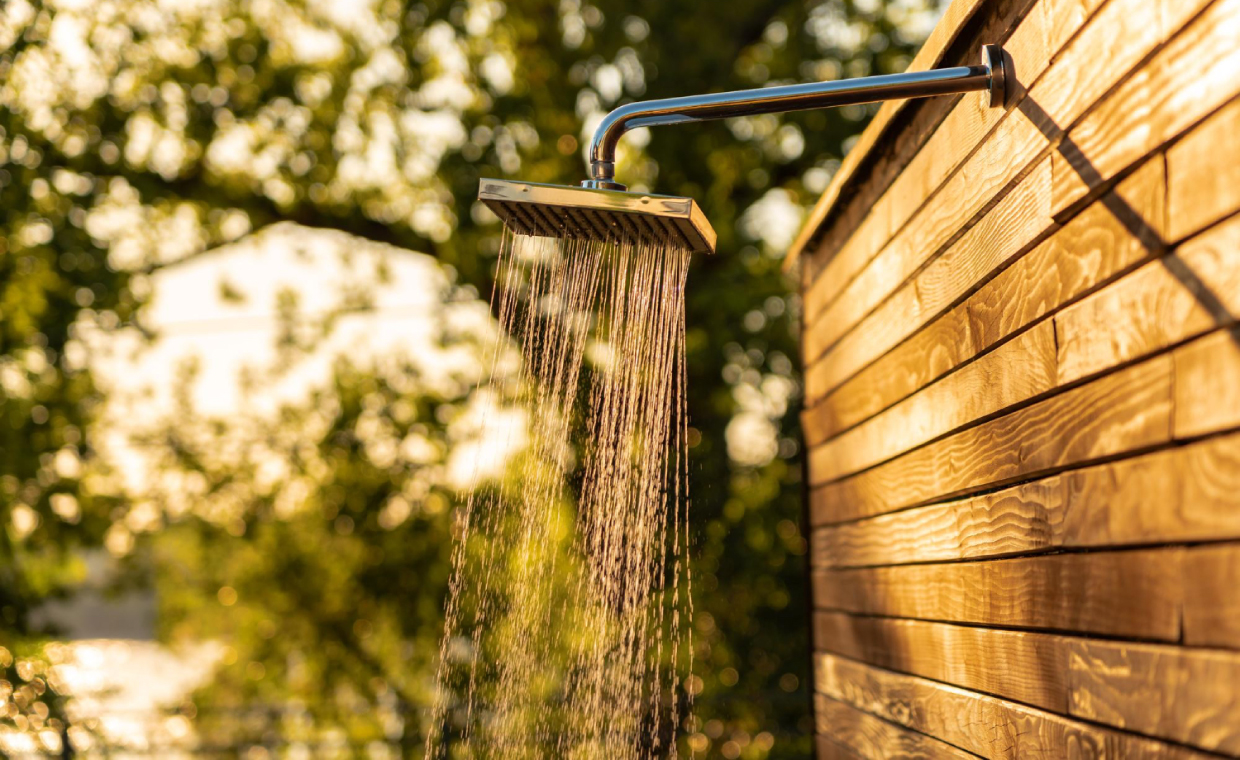
- Explore suitable mosaic styles for patios, pool areas, fountains, garden walls and outdoor showers.
- Find practical guidance on drainage, waterproofing, grout, movement joints and maintenance.
- See common installation mistakes that can cause cracking, water damage or premature tile failure.
- Understand when mosaics are worth the additional cost and when porcelain pavers may be a better choice.
For most outdoor floors, exterior-rated porcelain mosaic tile is the strongest all-around choice, primarily because true porcelain is defined as having water absorption of 0.5% or less when tested according to ASTM C373. That low absorption helps porcelain cope with moisture and often with freeze-thaw exposure, although the Tile Council of North America (TCNA) emphasizes that low absorption alone does not guarantee frost resistance; the specific manufacturer’s exterior-use documentation still matters.
The answer changes with the project. Glass mosaics can be excellent for pools, fountains and exterior decorative walls, while natural stone can deliver exceptional architectural character when its absorption, abrasion resistance and freeze-thaw performance match the climate. For walking surfaces, specifications become more demanding because water, slope, contaminants, footwear and drainage all affect slip risk.
Solidshape explains how porcelain, glass, ceramic and natural stone mosaics behave outdoors, which technical ratings deserve attention and why the same tile may be suitable for a pool wall but inappropriate for an adjacent pool deck. Solidshape shares useful tips for choosing mosaic tiles for outdoor projects such as patios, fountains and garden walls.
What Are Outdoor Mosaic Tiles and Why Are They Popular?
Outdoor mosaic tiles are small-format ceramic, porcelain, glass or natural-stone units installed individually or, more commonly, supplied as sheets. Their relatively small tesserae allow a tiled surface to follow curves, changes in geometry and detailed layouts more easily than large-format tile.
Current commercial examples demonstrate how compact the format can be. American Olean’s Unglazed Mosaics include 1-by-1-inch and 2-by-2-inch porcelain pieces at approximately 1/4-inch thickness, while Bisazza’s Opera glass mosaic uses 25-by-25-mm tesserae, also approximately 1/4 inch thick.
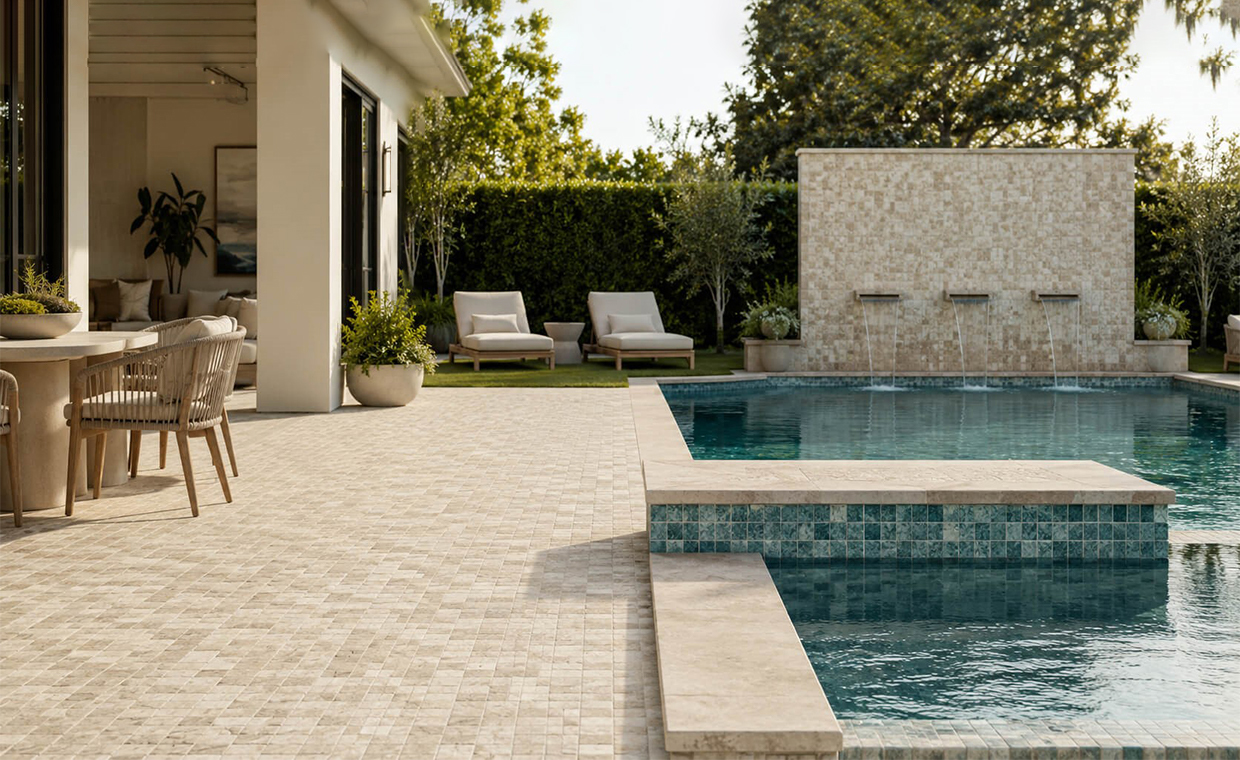
That small scale offers several design advantages outdoors. Mosaics can wrap pool curves, define stair details, create fountain patterns, introduce borders into larger paving fields and cover irregular architectural features. More grout joints also divide a surface into smaller units, which can provide useful texture underfoot, although grout lines should never be treated as proof that a floor is slip-resistant.
The more important definition is therefore not simply “mosaic” but “mosaic approved for the intended exposure.”
An outdoor project can expose tile to several very different environments:
- Exterior vertical surfaces such as garden walls
- Exterior pedestrian floors such as patios and walkways
- Frequently wet walking surfaces such as pool decks
- Continuously or periodically submerged surfaces such as pools and fountains
- Freeze-thaw climates
- Sun, thermal movement, salts, food oils and cleaning chemicals
A product that performs in one category should not automatically be assumed suitable for another.
What Are the Main Benefits of Outdoor Mosaic Tile?
Weather performance: Porcelain’s ≤0.5% absorption threshold is a strong starting point, although exterior approval and drainage still matter.
Wet-area adaptability: ANSI A326.3 includes an “Exterior, Wet” product-use category; the manufacturer declares suitability, and DCOF is not the only selection factor.
Design flexibility: Small chips handle tighter radii and patterned transitions around spas, fountains and steps.
Long service potential: Some ceramic-tile environmental declarations model a 75-year reference service life in a properly designed building assembly, reinforcing that installation quality matters.
Where Do Outdoor Mosaic Tiles Work Best?
Use exterior-rated porcelain mosaics on patios, walkways and outdoor showers when approved for the expected traffic and wet conditions. Pool waterlines, fountains and submerged features suit glass or porcelain systems explicitly approved for immersion; LATICRETE calls for about 95–100% adhesive coverage in submerged tile work. Natural stone and pebble mosaics fit garden walls, accents and selected floors when the stone is climate-suitable.
Avoid glossy wall-only glass on walking surfaces, indoor-only ceramic in freeze-prone climates, and any mosaic over unstable, poorly drained or inadequately waterproofed substrates.
Which Design Styles Work Well Outdoors?
Modern Geometric Porcelain
Hexagons, penny rounds and linear patterns suit contemporary patios and outdoor kitchens, especially in matte or textured finishes.
Luminous Pool and Fountain Glass
Blue, aqua, white and iridescent glass intensify reflected light at waterlines and feature walls. Use only products approved for the exact exterior or submerged application; ANSI A137.2-related guidance requires manufacturers to state suitable areas of use for relevant mounted glass assemblies.
Natural Stone and Pebble
Travertine, marble, slate and pebble mosaics connect visually with planting, coping and timber. Natural Stone Institute guidance emphasizes matching stone characteristics to climate and weather.
Outdoor Mosaic Tile Selection Checklist
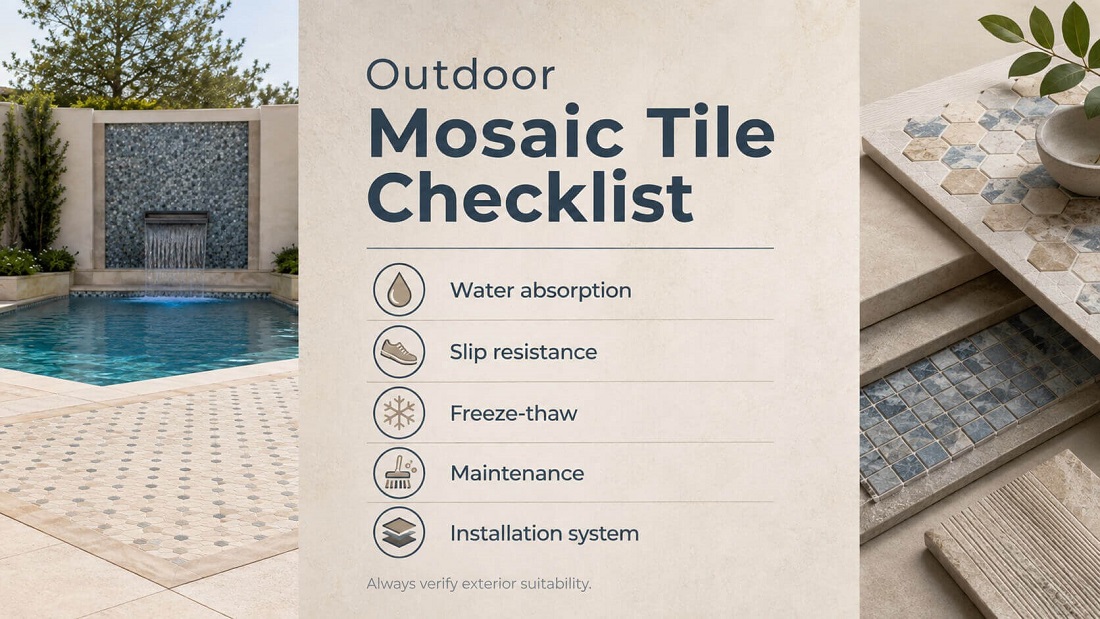
- Application: Confirm exterior wall, floor, pool or submerged approval.
- Water absorption: For porcelain, verify ≤0.5% under ANSI A137.1/ASTM C373.
- Freeze-thaw: In freezing climates, look for tested suitability; ASTM C1026 evaluates freeze-thaw resistance.
- Wet traction: Seek an ANSI A326.3 “Exterior, Wet” declaration and assess drainage, contaminants, texture and maintenance.
- Assembly: Specify compatible substrate, waterproofing where required, exterior mortar, grout and movement joints. TCNA notes grout joints are not waterproof.
- Maintenance/budget: Porcelain and glass are generally simpler to maintain; natural stone may need specialized cleaners and an appropriate impregnating sealer.
How Do the Main Outdoor Options Compare?
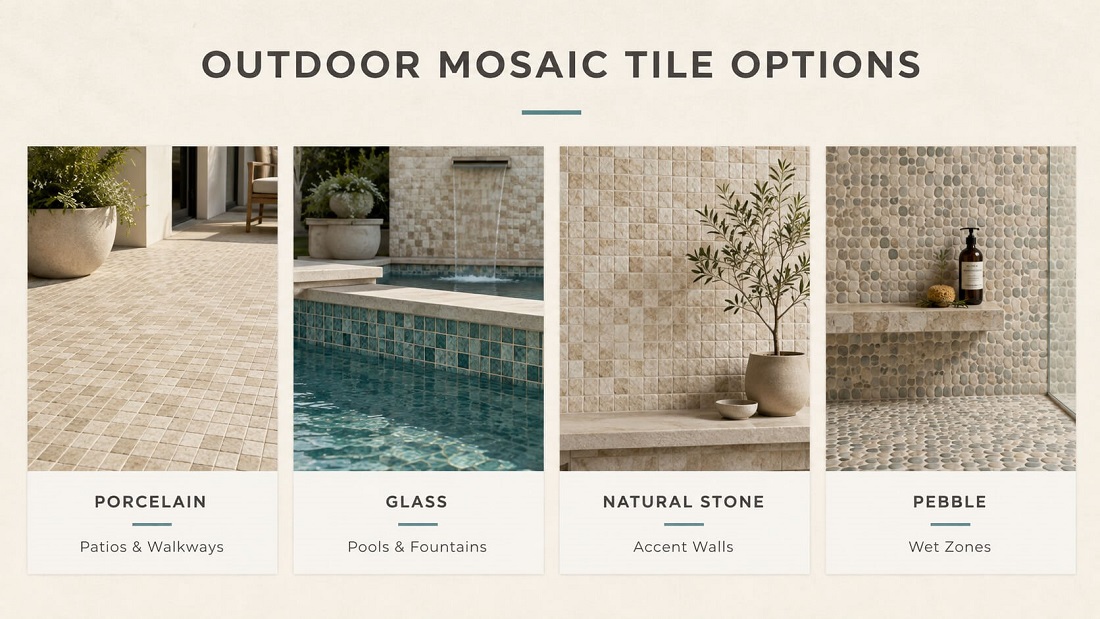
| Material/Option | Appearance | Durability with data | Maintenance | Approx. 2026 U.S. material cost | Best use case |
| Porcelain mosaic | Matte, stone-look, geometric | ≤0.5% absorption for porcelain | Low | ~$3–$22+/sq. ft. | Best all-round mosaic for exposed floors |
| Glass mosaic | Reflective, saturated | Exterior/submerged use must be manufacturer-approved | Low | ~$7–$16+/sq. ft. | Pools, fountains, feature walls |
| Natural stone mosaic | Veined, textured | Performance varies by stone and climate | Medium-high | ~$7–$14+/sq. ft. | Premium walls, selected floors |
| Pebble mosaic | Organic, tactile | Stone-dependent; many grout joints | Medium-high | ~$7–$18+/sq. ft. | Spa-like showers, garden accents |
| Porcelain paver | Large, minimal joints | Current 20 mm examples show <0.5% absorption and DCOF ≥0.55 | Low | ~$4.50–$6.50+/sq. ft. | Better for broad patio fields |
Prices are material-only examples from current U.S. retail listings and vary by brand, finish and pattern.
How Should Outdoor Mosaic Tile Be Maintained, and How Long Can It Last?
Keep drainage paths open, remove organic buildup, and use cleaners compatible with the tile and grout. The Natural Stone Institute warns that vinegar, lemon and other acids can etch calcareous stones; sealing should follow stone- and sealer-specific guidance. A fixed exterior lifespan is not responsible to promise: standing water, voids, movement and incompatible setting materials can shorten assembly life. TCNA specifically warns that water and ice trapped in grout joints or setting-bed voids can damage otherwise frost-resistant installations.
What Common Mistakes Cause Outdoor Mosaic Failure?
Common errors are choosing by color instead of application rating, assuming grout is waterproof, using indoor adhesives, ignoring movement joints, leaving poor drainage, and specifying polished or wall-rated products for wet floors. TCNA notes that even frost-resistant tile can be damaged when water sits in grout joints or setting-bed voids.
Is Outdoor Mosaic Tile Worth It?
Yes, when mosaics solve a real design problem: curves, waterlines, patterned accents, small wet zones or high-detail surfaces. For a large plain patio, a 20 mm porcelain paver may be more economical and easier to maintain because it creates a field with far fewer joints. Mosaic earns its premium where adaptability or visual detail matters, provided the complete exterior system is correctly specified and installed.
Also Read: Tips to Choosing the Best Tiles for Bathroom Flooring
Frequently Asked Questions – Outdoor Mosaic Tiles
01. Can all mosaic tiles be used outdoors?
No. The manufacturer must approve the product for the intended exterior condition; appearance or material name alone does not establish exterior suitability.
02. Is porcelain mosaic tile the best outdoor option?
For many exposed floors, yes. Its ≤0.5% water absorption is advantageous, but traction, freeze-thaw suitability and drainage still require verification.
03. Can glass mosaic tile be used outdoors?
Yes, when rated for that use. Pools need compatible backing, mortar, waterproofing and high bond coverage.
04. Are mosaic tiles safe for patio floors?
They can be if floor-rated and suitable for exterior wet use. ANSI A326.3 also requires considering drainage, contaminants, wear and maintenance.
05. Do outdoor mosaics need sealing?
Porcelain and glass generally do not need stone sealer. Natural stone may benefit from one; follow stone- and sealer-specific guidance.
06. Can mosaics be used in pools and fountains?
Yes, if the tile and complete installation system are approved for continuous immersion. Submerged tile requires particularly high mortar coverage.
07. Are outdoor mosaics frost-proof?
“Frost-resistant” is safer terminology. TCNA says ASTM C1026 and C373 can support exterior selection, but drainage and installation remain essential.
08. How long do outdoor mosaic tiles last?
There is no universal exterior lifespan. Some ceramic-tile LCAs use a 75-year reference service life, but actual performance depends on climate, substrate, drainage and maintenance.
Author & Expert Review
Written & Verified By:  Shekhar J. Parikh – Co Founder – Gharpedia | Director – SDCPL

| Credentials: Director and Consulting Engineer at Sthapati Designers & Consultants Pvt. Ltd., with over 40 years of experience in civil engineering, project execution, and construction management. Experience: Civil engineering professional with 40+ years of practical experience across Gujarat and Maharashtra, specializing in construction projects, project execution, quality control, and construction management. Expertise: Specializing in civil engineering, construction management, project execution, site practices, and quality control. He reviews technical content to ensure it reflects practical site knowledge, industry standards, and best practices, while supporting informed decision-making related to property buying, selling, and renting. Find him on: LinkedIn |